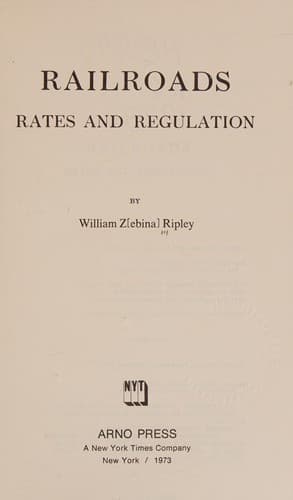
Railroads: Rates and RegulationsRipley, William Zebina
History
Railroads: Rates and Regulations
Ripley, William Zebina
Railroads -- Freight -- Rates -- United States; Railroads and state -- United States
Our purpose is not to pass judgment on any one,
but merely to call attention to the possible effect of such practices
upon the process of industrial development.
Centralization, or concentration of population, industry and wealth
is characteristic of all progressive peoples at the present time.
Great economic advantages, through division of labor and cheapened
production, have resulted; but, on the other hand, manifold evils
have followed in its train. Sometimes it appears as if American
railway practices, in granting commodity and flat long-distance
rates so freely, operated in some ways to retard this tendency. But
the influence is not all in that direction. Many staple industries,
utilizing the raw material at their doors, might supply the needs of
their several local constituencies, were it not that their rise is
prevented by long-distance rates from remote but larger centres of
production. Denver, in striving to establish paper mills to utilize its
own Colorado wood pulp, is threatened by the low rates from Wisconsin
centres. Each locality, ambitious to become self-supporting, is
hindered by the persistency of competition from far away cities. This
is particularly true of distributive business. The overweening ambition
of the great cities to monopolize the jobbing trade, regardless of
distance, has already been discussed. And it follows, of course, that
the larger the city the more forcibly may it press its demands upon the
carriers for low rates to the most remote hamlets. The files of the
Interstate Commerce Commission are stocked with examples of this kind.
The plea of the smaller cities and the agricultural states--Iowa, for
example--for a right to share in the jobbing naturally tributary to
them by reason of their location, formed no inconsiderable element in
the recent popular demand for legislation by the Federal government.
Public-domain text, read in full here on John Shaqi.
Reviews
Reviews
No reviews yet
Be the first to share your thoughts on this work.
Elsewhere in the archive
Join the Discussion
Join the discussion
Sign in to leave a comment or review.
Sign InorCreate an account