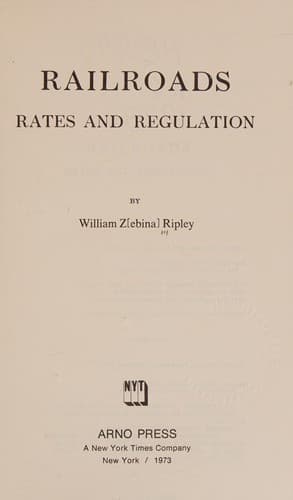
Railroads: Rates and RegulationsRipley, William Zebina
History
Railroads: Rates and Regulations
Ripley, William Zebina
Railroads -- Freight -- Rates -- United States; Railroads and state -- United States
At times it is inevitable that cost of service and value of service
considerations come flatly into opposition. Usually, as in the
California raisin case or in the grant of low rates on Oregon lumber
east bound about 1893, they reinforce one another; that is to say,
the lower rate given to build up business obtains on a service given
at lower cost. But it sometimes happens that shipments of the same
commodities over a line in opposite directions may occur and that the
lower rate applies to the (presumably) more costly service. In 1906 a
manufacturer in Menasha, Wis., complained to the Interstate Commerce
Commission[155] that his rates on woodenware to the Pacific slope
were ten cents per 100 lbs. higher than were rates on the same goods
between the same points east bound, _notwithstanding_ the fact that the
empty car mileage west bound was then three times as great as in the
contrary direction. The movement of empties west bound would certainly
seem to justify as low if not lower rates on the basis of comparative
cost of operation, supposing that there was coincidence in time.
Only one satisfactory explanation for this apparent anomaly suggests
itself; viz., that this low eastbound rate was given to build up a new
industry in the West. In other words, the cost of service, a dependable
guide for a road in a static condition, failed of effect upon a line
possessed of great dynamic possibilities. Occasionally opposition of
principles like this may occur in questions of classification. It may
temporarily be worth while, in order to build up a new industry, to
accord a lower rating to a commodity actually more valuable or more
expensive to handle than others. Here again the dynamic force in the
value of service principle out-weighs all other considerations of
relative cost of service.
The value of service principle in general fails, not only in the
determination of absolutely reasonable rates, but it is inadequate
also to the solution of perhaps the more difficult problem of relative
rates. This question of relativity is twofold; first as between
different places, and secondly as between different commodities.
These are, in other words, the problems respectively of distance
tariffs and of classification. The manner in which distance tariffs
evolve, has already been discussed, and it is evident that the cost
of service principle is of fundamental importance, even though it be
tempered by considerations of commercial expediency, that is to say,
by the necessity of at all times under stress of competition, charging
only what the traffic will bear. But while the value of service
principle--charging according to demand in other words--applies at the
competitive points, the other principle of relative cost should be the
fundamental one in fixing upon the scale of local non-competitive rates.
Public-domain text, read in full here on John Shaqi.
Reviews
Reviews
No reviews yet
Be the first to share your thoughts on this work.
Elsewhere in the archive
Join the Discussion
Join the discussion
Sign in to leave a comment or review.
Sign InorCreate an account