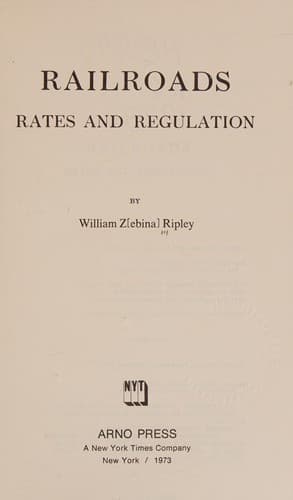
Railroads: Rates and RegulationsRipley, William Zebina
History
Railroads: Rates and Regulations
Ripley, William Zebina
Railroads -- Freight -- Rates -- United States; Railroads and state -- United States
And then again there are all the possibilities of the printer's art to
be used, in connection with the preparation of elaborate tariffs.[176]
The tariff of "33 cents per hundredweight" may conceivably be a
typographical error, to be speedily corrected in a supplementary
hektograph sheet filed the next day. Involved and elaborate rate
sheets may be reprinted with only one little change among a thousand
items left as before. Different tariffs may interlock with complicated
cross references. In one case in 1902 it took seven different tariffs
to enable one to compute the rate for a given shipment. In twelve
months, to December 1907, there were filed with the Interstate Commerce
Commission 220,982 such tariffs, each containing changes in rates or
rules. Some "expire with this shipment,"--and some agree to "protect"
any rate of any competing carrier, that is to say, to meet it if it
happen to be lower.
An entirely different plan of rebating,--and a most effective one,--has
to do with apparently unrelated commercial transactions.[177] Many
shippers are large sellers of supplies to the railroad. How easy then
to make a concession in rates to an oil refinery for example, by
paying a little extra for the lubricating oil bought from a subsidiary
concern. The Federal authorities in recent years and especially
in connection with the prosecution of the Standard Oil Company in
1908-1911, have discovered the most extraordinary variations in the
prices paid by railroads for supplies. Independent concerns were often
not allowed to compete in the sale of lubricants at all. It would be
difficult to prove any connection between so widely separate sets of
dealings; and yet it is clear that rebates are often given in this way.
Or even more fruitful as an expedient, especially in these later days
when rebating is a serious offence, why not confer a favor by extra
liberality in allowances for damages to goods in transit? In 1909 the
so-called Beef Trust was specifically ordered by the Attorney General
of the United States to desist from such practices. Positively the only
way to detect such fictitious allowances for damages, is to ferret out
each case by itself. This is a slow and necessarily expensive process.
Damage allowances and _quid pro quo_ transactions in the purchase of
supplies, are indeed almost "smokeless rebates," as they have aptly
been termed.
Public-domain text, read in full here on John Shaqi.
Reviews
Reviews
No reviews yet
Be the first to share your thoughts on this work.
Elsewhere in the archive
Join the Discussion
Join the discussion
Sign in to leave a comment or review.
Sign InorCreate an account