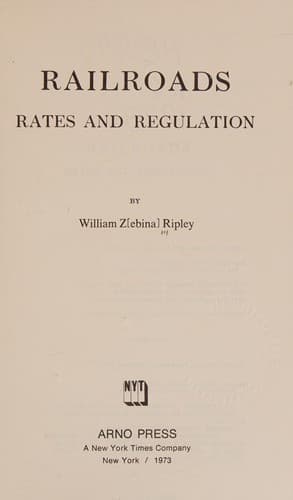
Railroads: Rates and RegulationsRipley, William Zebina
History
Railroads: Rates and Regulations
Ripley, William Zebina
Railroads -- Freight -- Rates -- United States; Railroads and state -- United States
Any unreasonable departure from a tariff graded in some proportion
according to distance is known as local discrimination. It constitutes
one of the most difficult and perplexing problems in transportation.
Personal discrimination now happily having been practically eliminated
since the enactment of the Elkins Amendments to the Act to Regulate
Commerce, this issue of local discrimination under the rehabilitated
long and short haul clause, has recently assumed an added significance.
A merchant of Wilkesbarre, Pennsylvania, purchased a carload of
potatoes at Rochester, New York, and had the freight bill made for a
delivery to Philadelphia, because the freight to Philadelphia was less
than it was to Wilkesbarre, which is 143 miles nearer. He stopped the
potatoes at Wilkesbarre, unloaded them, and paid the freight. A few
days later he received a bill from the Lehigh Valley Company for twelve
dollars additional freight. If the potatoes had gone to Philadelphia,
he would have paid forty-eight dollars freightage. As they stopped at
Wilkesbarre, he had to pay sixty dollars; that is, twelve dollars for
not hauling the carload 143 miles.[200]
A merchant in Montgomery, Alabama, shipped two carloads of fruit jars
from Crawfordsville, Indiana, to Montgomery. He shipped them to Mobile
and then paid the local rate from Mobile back, those fruit jars going
through Montgomery on the way out. By having them hauled 350 miles
farther, he saved seventy-five dollars on the two carloads.
On first-class goods, at one time, the rate from Louisville to
Montgomery, was $1.26 per hundredweight. On to Mobile, 180 miles
further south, it was only ninety cents. In the same territory the rate
on kerosene oil from Cincinnati at times has been three times as much
to interior points as to New Orleans, three times as far. West of the
Missouri river and in the Rocky mountain area similar complaints are
common. Denver, Colorado, pays $1.79 per hundredweight on cotton piece
goods, in small lots, hauled 2,000 miles from Boston; while the rate
to San Francisco, 1,400 miles further away, on the same line, is only
$1.50. This discrepancy is even greater in wholesale rates. No carload
rating is given to Denver; while for similar shipments to the coast the
rate is only one dollar per hundredweight. In the opposite direction,
sugar is carried from San Francisco through Denver to Kansas City for
sixty-five cents per hundredweight, as compared with a rate of one
dollar if the sugar is stopped at Denver. Smaller places in the West
afford equally striking instances. The rate on rope from San Francisco
to Independence, Kansas, is seventy-five cents; while the same goods
are hauled on through Independence, Kansas, much farther, to Missouri
river points for sixty cents per hundred pounds. Wichita, Kansas,
complains that cotton piece goods from New York by way of Galveston
are rated at $1.36; while by the same route Kansas City, 225 miles
Public-domain text, read in full here on John Shaqi.
Reviews
Reviews
No reviews yet
Be the first to share your thoughts on this work.
Elsewhere in the archive
Join the Discussion
Join the discussion
Sign in to leave a comment or review.
Sign InorCreate an account