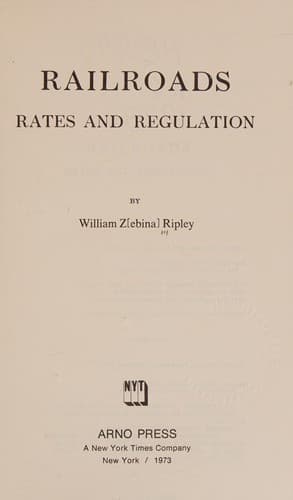
Railroads: Rates and RegulationsRipley, William Zebina
History
Railroads: Rates and Regulations
Ripley, William Zebina
Railroads -- Freight -- Rates -- United States; Railroads and state -- United States
"On the coast of Delaware, a few years ago, there was a place
which we shall call X, well suited for oyster-growing, but
which sent very few oysters to market, because the railroad
rates were so high as to leave no margin of profit. The local
oyster-growers represented to the railroad that if the rates
were brought down to one dollar per hundred pounds, the
business would become profitable and the railroad could be sure
of regular shipments at that price. The railroad men looked
into the matter. They found that the price of oysters in the
Philadelphia market was such that the local oystermen could
pay one dollar per hundred pounds to the railroad and still
have a fair profit left. If the road tried to charge more, it
would so cut down the profit as to leave men no inducement to
enter the business. That is, those oysters would bear a rate
of one dollar per hundred, and no more. Further, the railroad
men found that if they could get every day a carload, or nearly
a carload, at this rate, it would more than cover the expense
of hauling an extra car by quick train back and forth every
day, with the incidental expenses of interest and repairs. So
they put the car on, and were disappointed to find that the
local oyster-growers could only furnish oysters enough to fill
the car about half full. The expense to the road of running
it half full was almost as great as of running it full; the
income was reduced one-half. They could not make up by raising
the rates, for these were as high as the traffic would bear.
They could not increase their business much by lowering rates.
The difficulty was not with the price charged, but with the
capacity of the local business. It seemed as if this special
service must be abandoned.
"One possibility suggested itself. At some distance beyond
X, the terminus of this railroad, was another oyster-growing
place, Y, which sent its oysters to market by another route.
The supply at Y was very much greater than at X. The people
at Y were paying a dollar a hundred to send their oysters to
market. It would hardly cost twenty cents to send them from Y
to X. If, then, the railroad from X to Philadelphia charged
but seventy-five cents a hundred on oysters which came from
Y, it could easily fill its car full. This was what they did.
They then had half a carload of oysters grown at X, on which
they charged a dollar, and half a carload from Y on which they
charged seventy-five cents for exactly the same service.
Public-domain text, read in full here on John Shaqi.
Reviews
Reviews
No reviews yet
Be the first to share your thoughts on this work.
Elsewhere in the archive
Join the Discussion
Join the discussion
Sign in to leave a comment or review.
Sign InorCreate an account