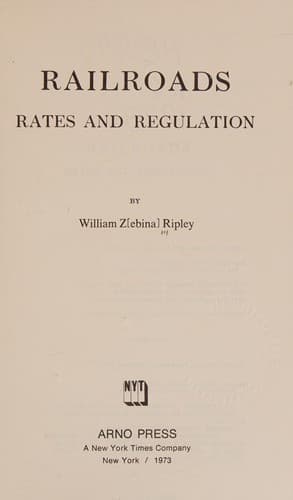
Railroads: Rates and RegulationsRipley, William Zebina
History
Railroads: Rates and Regulations
Ripley, William Zebina
Railroads -- Freight -- Rates -- United States; Railroads and state -- United States
Missouri river cities for rate making to points beyond.[225]
The main difficulty with any system of basing points or lines, which
so flagrantly violates the distance principle, is first of all to
determine at what points to base; and thereafter to accommodate the
system to the normal growth and development of the country. The system
is inelastic. It tends to break down of its own weight. It must
enlarge, if at all, by fits and starts, in each case with violent
dislocation of trade. A generation ago towns in Iowa complained that
the Mississippi river was a basing line. Then, when the Missouri river
line was substituted, an outcry rose from all the points in Nebraska.
The persistent complaint from Denver against its rate adjustment as
compared with Kansas City,--a competitive distributing centre,--well
exemplifies it. The Denver Chamber of Commerce intervenes, and proposes
that the basing line be moved from the Missouri river out to Colorado
common points (like Denver). Indeed, in each case the argument in favor
of the change is identical. Each tier of complainants--thriving cities
which have recently come to more or less commercial maturity--plead
their inability to compete with the centres adopted some years ago for
basing purposes. Denver, for example, wishes to sell goods throughout
Utah. But its total charges there on goods purchased in the East amount
to eighty cents from Chicago to the Missouri river, plus $1.25 on to
Denver, plus $1.64 on to destination,--a sum of $3.69 per hundred
pounds. The Kansas City dealer, on the other hand, gets a low base
rate of only eighty cents with a single additional rate directly out
to Utah of $2.05. In other words, the latter can lay down his goods
in Utah for $2.85 as against $3.69 paid by the Denver competitor. The
point to be carried forward, however, is not so much the disparity
against Denver, as the fact that the moment Denver is promoted to be
a basing point it becomes defendant in a complaint of precisely the
same sort, brought by the places still further west. This inelasticity
of basing point schemes, together with their inability to expand
without abrupt dislocations of trade, is apparent everywhere in the
South. Just as Chattanooga complains against Nashville, so the little
intermediate stations between Chattanooga and Atlanta, as our diagram
on page 240 showed, become restive under rates of $1.27 as compared
with a rate twenty-one cents lower charged on to Atlanta. The system of
basing points or lines may be an inevitable concomitant of industrial
immaturity; but it is none the less difficult to defend as a permanent
system or as one inherently just. And its final relegation to the scrap
heap, in favor of a system of rates graded more or less according to
distance, is ardently to be desired.[226]
* * * * *
Public-domain text, read in full here on John Shaqi.
Reviews
Reviews
No reviews yet
Be the first to share your thoughts on this work.
Elsewhere in the archive
Join the Discussion
Join the discussion
Sign in to leave a comment or review.
Sign InorCreate an account