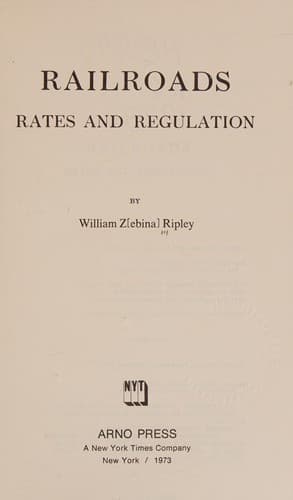
Railroads: Rates and RegulationsRipley, William Zebina
History
Railroads: Rates and Regulations
Ripley, William Zebina
Railroads -- Freight -- Rates -- United States; Railroads and state -- United States
Mr. ROBINSON. Oh, no; to any point on the Central Traffic
Association territory. In other words, it may go to Cleveland.
SENATOR DOLLIVER. Why do they bill it to Rochester?
Mr. ROBINSON. In order to get the benefit of keeping it in
transit fifteen days without any extra cost, first.
SENATOR DOLLIVER. I do not see how that would affect the
question of billing it to Rochester.
Mr. ROBINSON. Because that enables the wholesaler to have
fifteen days extra time in which to sell the lumber.
The CHAIRMAN. Why haul it all around the country and then
reduce the rate on that long haul?
Mr. ROBINSON. In order that roads that are not entitled
naturally to this traffic may by this process get the traffic.
SENATOR DOLLIVER. What roads from Mississippi to East St. Louis?
Mr. ROBINSON. Any of the trunk lines--the Illinois Central,
the Louisville or the Southern Railway lines. The roads
in Mississippi south of the river are not parties to this
arrangement, you understand. In fact, as fast as they find it
out they break it up, or try to. They do not want their traffic
diverted.
SENATOR KEAN. Does it not come down to this, that some road is
trying to cheat another on the use of its cars?
Mr. ROBINSON. Not only that, but it is trying to get traffic
that does not belong to it.[286]
Wherever a large volume of traffic is moving by an unnatural route,
the first explanation which arises therefore is that rebates or
rate-cutting are taking place.[287]
[Illustration]
Public-domain text, read in full here on John Shaqi.
Reviews
Reviews
No reviews yet
Be the first to share your thoughts on this work.
Elsewhere in the archive
Join the Discussion
Join the discussion
Sign in to leave a comment or review.
Sign InorCreate an account