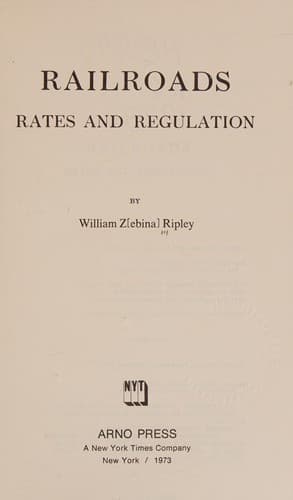
Railroads: Rates and RegulationsRipley, William Zebina
History
Railroads: Rates and Regulations
Ripley, William Zebina
Railroads -- Freight -- Rates -- United States; Railroads and state -- United States
Agreements between carriers previous to 1887 were often employed to
obviate unnecessary waste in transportation. The division of territory
between the eastern and western lines into the southern states is a
case in point. Thirty years ago competition for trade throughout the
South was very keen between the great cities in the East and in the
Middle West. Direct lines to the northwest from Atlanta and Nashville
opened up a new avenue of communication with ambitious cities like
Chicago, St. Louis and Cincinnati. The state of Georgia constructed
the Western and Atlantic Railroad in 1851 for the express purpose
of developing this trade. As western manufactures developed, a keen
rivalry between the routes respectively east and west of the Alleghany
mountains into the South was engendered. A profitable trade in food
products by a natural, direct route from the Ohio gateways was,
however, jeopardized by ruinous rates made by the warring trunk lines
to the northern seaboard. Corn, oats, wheat and pork came down the
coast and into the South through the back door, so to speak, by way
of Savannah and other seaports. On the other hand the eastern lines
into the South were injuriously affected by the retaliatory rates on
manufactured goods made by the western lines for shipments from New
York and New England. Freight from each direction was being hauled
round three sides of a rectangle. Finally in 1878 a reasonable remedy
was found in a division of the field and an agreement to stop all
absurdly circuitous long hauls into one another's natural territory. A
line was drawn through the northern states from Buffalo to Pittsburg
and Wheeling; through the South from Chattanooga by Montgomery, Ala.,
to Pensacola. Eastern lines were to accept goods for shipment only
from their side of this line to points of destination in the South
also on the eastern side of the boundary. Western competitors were to
do the same. The result was the recognition of natural rights of each
to its territory. This agreement has now formed the basis of railway
tariffs into the southern states for almost a generation. Similar
agreements, on a less extensive scale, are commonly used to great
advantage. Thus in the "common point" territory formerly tributary to
Wilmington, Savannah and Charleston, the first named city insisted upon
its right to an equal rate with the other two, no matter how great the
disparity of distance. The Southern Railway and Steamship Association
arbitrated the matter, fixing a line beyond which Wilmington was to be
excluded.[313] Obviously such agreements have no force in law at the
present time. The only way to give effect to them is for connecting
carriers to refuse to make a joint through rate. This effectually bars
the traffic. Moreover entire unanimity of action is essential. Every
road must be a party to the compact. Otherwise the traffic will reach
its destination by shrunken rates and a more circuitous carriage even
than before.
Public-domain text, read in full here on John Shaqi.
Reviews
Reviews
No reviews yet
Be the first to share your thoughts on this work.
Elsewhere in the archive
Join the Discussion
Join the discussion
Sign in to leave a comment or review.
Sign InorCreate an account