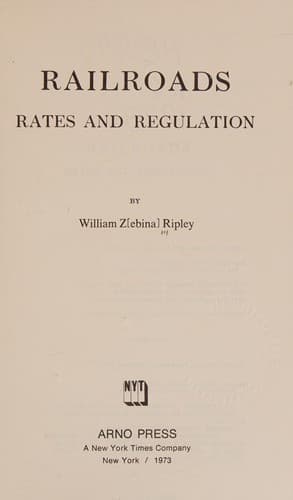
Railroads: Rates and RegulationsRipley, William Zebina
History
Railroads: Rates and Regulations
Ripley, William Zebina
Railroads -- Freight -- Rates -- United States; Railroads and state -- United States
The classification of all these articles is a factor of primary
importance in the making of freight rates both from a public and
private point of view. Attention has been directed of late to its
significance and importance to the private shipper, by reason of the
use made of it in the advances of freight rates which have taken place
throughout the country within the past decade. Its public importance
has not been fully appreciated until recently as affecting the general
level of railway charges. So little was its significance understood,
that supervision and control of classification were not apparently
contemplated by the original Act to Regulate Commerce of 1887. The
anomaly existed for many years, therefore, of a grant of power intended
to regulate freight rates, which, at the same time, omitted provision
for control over a fundamentally important element in their make-up.
The Interstate Commerce Commission, however, assumed jurisdiction over
the matter: and for more than twenty years, despite doubts expressed by
the Department of Justice as to its legality, passed upon complaints as
to unreasonable classification without protest even from the carriers
themselves. Control over it has now been assured beyond possibility of
dispute by the specific provisions of the Hepburn Act of 1910.
The freight rate upon a particular commodity between any given points
is compounded of two separate and distinct factors: one having to do
with the nature of the haul, the other with the nature of the goods
themselves. Two distinct publications must be consulted in order to
determine the actual charge. Although both of them usually bear the
name of a railway and are issued over its signature, they emanate,
nevertheless, from entirely different sources. The first of these is
known as the Freight Tariff. It specifies rates in cents per hundred
pounds for a number of different classes of freight, numerically
designated, between all the places upon each line or its connections.
Thus the tariff of the New York Central & Hudson River Railroad gives
rates per hundred pounds from New York to several hundred stations,
for first, second, third, etc., classes. This freight tariff, however,
contains no mention whatever of commodities by name. The second
publication which must be consulted supplies this defect. This is
known as the Classification. Its function is to group all articles
more or less alike in character, so far as they affect transportation
cost, or are affected in value by carriage from place to place. These
groups correspond to the several numerical classes already named in
the freight tariff. Thus dry goods or boots and shoes are designated
as first class. Turning back to the freight tariff, the rate from
New York, for example, to any particular place desired, for such
first-class freight, is then found in cents per hundred pounds. It
thus appears, as has been said, that a freight rate is made up of
two distinct elements equal in importance.
Public-domain text, read in full here on John Shaqi.
Reviews
Reviews
No reviews yet
Be the first to share your thoughts on this work.
Elsewhere in the archive
Join the Discussion
Join the discussion
Sign in to leave a comment or review.
Sign InorCreate an account