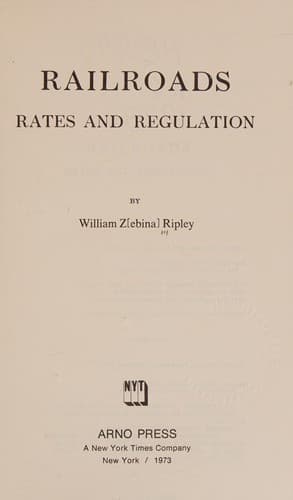
Railroads: Rates and RegulationsRipley, William Zebina
History
Railroads: Rates and Regulations
Ripley, William Zebina
Railroads -- Freight -- Rates -- United States; Railroads and state -- United States
Freight tariffs and classifications are as distinct and independent
in source as they are in nature. Tariffs are issued by each railway,
by and for itself alone and upon its sole authority. Classifications,
on the other hand, do not originate with particular railways at all;
but are issued for them by coöperative bodies, known as classification
committees. These committees are composed of representatives from
all the carriers operating within certain designated territories.
In other words, the United States is apportioned among a number of
committees, to each of which is delegated by the carriers concerned,
the power over classification; that is to say, the right to assign
every commodity which may be shipped or received to any particular
group of freight ratings. This delegation of authority is always
subject, however, to the right of filing whatever exceptions to the
classification any railway may choose independently to put in force.
These exception sheets contain the so-called commodity tariffs, to
be subsequently described, which stand out in sharp relief against
the so-called class rates. Such exceptions are independently filed by
each railway at Washington and do not generally form integral parts
of the volume issued by the classification committee, except in the
southern states. New editions of these classifications are published
from time to time as called for by additions or amendments, the
latest, of course, superseding all earlier ones. Thirty-seven such
issues have already appeared in series in trunk line and southern
territory, while fifty have been put forth in western territory, since
the practice was standardized in 1888. At the present time freight
classification for all the railways of the United States is performed
mainly by three committees, known as the Official, the Southern and
the Western, with headquarters, respectively, in New York, Atlanta
and Chicago. Each of these three committees has jurisdiction over a
particular territory. Thus the Official Classification prevails east
of Chicago and north of the Ohio and the Potomac; the Southern, over
the remaining part of the country east of the Mississippi; and the
Western, throughout the rest of the United States. In addition to these
three primary classifications there is also another, issued by the
Transcontinental Freight Bureau, with headquarters at Chicago. This
committee has supervision over classification upon the Pacific coast
business. A number of the states also, notably Illinois, Iowa and most
of the southwestern commonwealths, promulgate state classifications
having relation, however, only to local business within their several
jurisdictions. These are prescribed by law and represent modifications
to suit peculiar exigencies or to foster local trade ambitions. There
are also a number of other coöperative local railway committees,
each dealing with the special concerns of its own territory, and
representing the joint interests of the railways therein included to
Public-domain text, read in full here on John Shaqi.
Reviews
Reviews
No reviews yet
Be the first to share your thoughts on this work.
Elsewhere in the archive
Join the Discussion
Join the discussion
Sign in to leave a comment or review.
Sign InorCreate an account