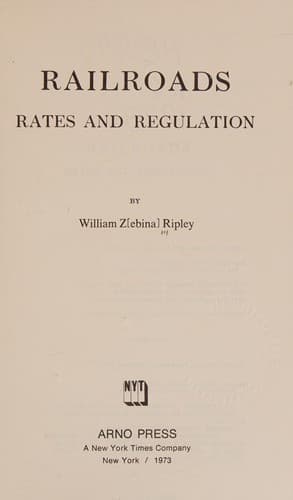
Railroads: Rates and RegulationsRipley, William Zebina
History
Railroads: Rates and Regulations
Ripley, William Zebina
Railroads -- Freight -- Rates -- United States; Railroads and state -- United States
Commodity rates as a means for enabling shippers to reach beyond
their immediate territory and gain an entrance to new markets, form
an entirely distinct variety of charges from those quoted in the
classified tariffs. These are special rates made to suit particular
contingencies,[351] although, of course, under the law they must be
filed with the Interstate Commerce Commission in the same manner. Such
commodity rates, however, do not apply to persons but to localities.
Although granted to shippers in a particular place to build up an
industry, the privilege of shipment under the same conditions is
theoretically open, of course, to all others at that point. Such
commodity rates naturally apply to three sets of commercial conditions:
they either govern large shipments for long distances, as in the
case of live stock; or, if for short distances, they are confined to
commodities of the very lowest grade, such as lime, sand or paving
blocks; or else they are introduced to meet special conditions, such as
an irregular market or rapidly fluctuating competitive circumstances,
as in the case of goods for import or export. Such special rates are
almost invariably granted for carload lots alone. The reason is,
naturally, that it would not be worth while to make an exception to the
classified schedules for less than that amount. Moreover, it should
be observed, special rates of this sort are often introduced in order
to meet changeable competition, such as by steamship lines engaged in
export or import business. The classified ratings change but little,
and oftentimes remain the same for many years. But in all cases where
fluctuating conditions have to be met, commodity rates by the carload
are likely to appear. This is one reason why the transcontinental
tariffs, exposed to competition either by the Cape Horn or Panama
water routes, contain so large a proportion of commodity or carload
ratings.[352]
Public-domain text, read in full here on John Shaqi.
Reviews
Reviews
No reviews yet
Be the first to share your thoughts on this work.
Elsewhere in the archive
Join the Discussion
Join the discussion
Sign in to leave a comment or review.
Sign InorCreate an account