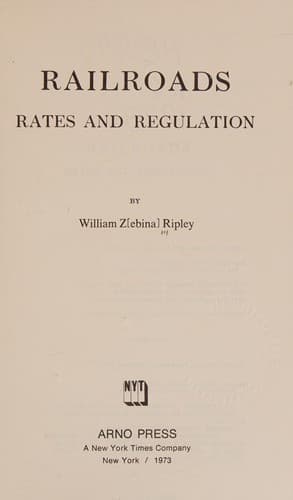
Railroads: Rates and RegulationsRipley, William Zebina
History
Railroads: Rates and Regulations
Ripley, William Zebina
Railroads -- Freight -- Rates -- United States; Railroads and state -- United States
The present threefold territorial division of the country, for
the purposes of classification, naturally affords all sorts of
possibilities in the way of veiled discrimination, not merely as
between persons but as affecting the interests of different competing
markets. Not only is there liability to confusion, but the way is
paved for all sorts of favoritism. Wherever shipment is made from one
classification territory to another, it is always possible to adjust
the rates with a view to local advantage. For instance, one of the
principal causes of complaint in the South is the advantage which
Nashville, Tennessee, enjoys through having all of its rates from
eastern and northern centres made upon the Official Classification.
Inasmuch as the rates under the Southern Classification are
considerably higher, this operates to place other competing cities in
the South under a distinct disability in competition with Nashville. It
is possible, therefore, for the Louisville & Nashville by this means to
build up one community at the expense of another. The same device gives
Richmond, Norfolk and the other Virginian cities a great advantage
over their competitors.[380] Again, rates from New York to Memphis and
New Orleans are made upon the Official Classification, by whatever
route; while to intermediate points, such as Vicksburg, Natchez,
and Baton Rouge, they go on the rates prescribed by the Southern
Classification, which are considerably higher. From New York to St.
Paul through Chicago, shipments are made on the low rate basis of the
Official Classification; while from Chicago to St. Paul they go under
the Western Classification. From Birmingham, Alabama, to St. Paul,
the rates as far as Chicago are based upon the Southern schedule, and
from thence on under the Western. From San Francisco to St. Paul, the
Western Classification prevails, unless the freight is carried under
the commodity rates of the Transcontinental schedule. The peculiar
situation of Nashville on shipments from the Northeast has already
been stated. This immediately complicates the rates from so-called
Cook County Junctions--that is to say, from Chicago territory. All
consignments for the entire distance are governed by the Southern
Classification. This, in face of the low Official Classification
rates from trunk line territory, operates as a discrimination against
Chicago. Even more complicated still are the combinations by which
rates are made from local points in the North into the Far Southwest.
And still farther complexity results from the existence, as already
mentioned, in several parts of the country, such as Iowa, Illinois,
Georgia, etc., of state classifications, prescribed by the railway
commissions. These, to be sure, are intended for application only
to local rates. But by this means, the jobbing interests of the
localities are protected, without at the same time giving consideration
to an equitable adjustment as between all the remoter interests
Public-domain text, read in full here on John Shaqi.
Reviews
Reviews
No reviews yet
Be the first to share your thoughts on this work.
Elsewhere in the archive
Join the Discussion
Join the discussion
Sign in to leave a comment or review.
Sign InorCreate an account