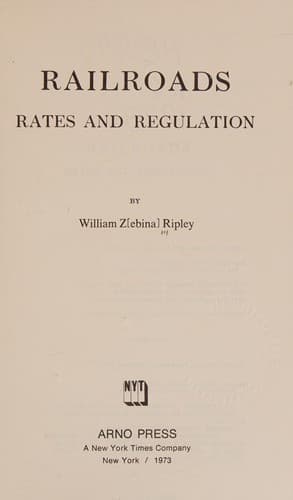
Railroads: Rates and RegulationsRipley, William Zebina
History
Railroads: Rates and Regulations
Ripley, William Zebina
Railroads -- Freight -- Rates -- United States; Railroads and state -- United States
This desirable end could never have been attained if the several
competing companies had not been able to act in coöperation. The
erroneous popular opinion that railway competition must be preserved
in the public interest, had it been legally enforced in this territory
a generation ago, would have prevented absolutely any comprehensive
solution of the problem. Until Congress abandons this theory, and
treats railways as essentially monopolistic, thereafter to be protected
and maintained as _beneficent_ monopolies through adequate governmental
supervision, the lesson of trunk line experience will not have been
learned. And, finally, the interesting fact that for almost thirty
years it has not been necessary to change either the main system or, in
many instances, the actual rates charged thereunder, is an offset to
the contention that success in railway operation is to be judged by the
instability of rates, seeking to follow constantly the ups and downs of
commercial conditions. Certain modifications, especially in export and
import traffic, or wherever water rates have to be made or met, are, of
course, inevitable. But it is absurd to reason from this that railway
tariffs in the main need to be continually jostled about at the behest
of the shipping public. Of course, if one railway changes its rates,
all the rest must follow. That is the principal reason why many of our
rate schedules have been as uncertain as the weather. But there is no
reason why, if all parties in competition keep good faith and observe
their tariffs, a schedule of class rates for domestic shipments should
not remain practically constant.
Take the rates on raw cotton from Mississippi river points like
Memphis to New England cities, for example. Was any staple product
ever subject to greater fluctuations in price than raw cotton, varying
as it has in the last few years, from five to fifteen cents a pound?
Yet through it all, good years and bad, whether for the planter or the
manufacturer, the freight rate has stood unchanged at fifty-five cents
per hundredweight. In the same way, within the limits hereafter to be
described, the trunk line rate system has endured for a generation.
Founded upon sound and, consequently, defensible principles, it has
promoted good feeling between railway and shipper. And, if the changes
of classification since 1900 had not been made, one may reasonably
doubt whether the demand for Federal legislation would have been any
more insistent throughout the eastern central states than it now is in
New England.
* * * * *
Public-domain text, read in full here on John Shaqi.
Reviews
Reviews
No reviews yet
Be the first to share your thoughts on this work.
Elsewhere in the archive
Join the Discussion
Join the discussion
Sign in to leave a comment or review.
Sign InorCreate an account