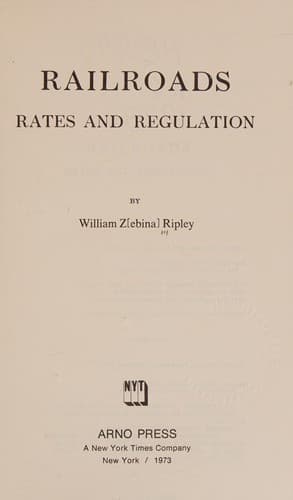
Railroads: Rates and RegulationsRipley, William Zebina
History
Railroads: Rates and Regulations
Ripley, William Zebina
Railroads -- Freight -- Rates -- United States; Railroads and state -- United States
An ingenious rate clerk named MacGraham, in the offices of the
Pennsylvania Railroad, proposed a comprehensive scheme for meeting
these difficulties which was first used for westbound rates on
December, 15, 1871. The Chicago-New York rate was to constitute a
basis, upon which all other rates were to be made in percentages,
according to their relative distance from New York.[399] Thus, assuming
Chicago to be 900 odd miles from New York, the rate from a point 600
miles inland would be about sixty-six and two-thirds per cent. of the
Chicago rate, whatever that might be. Whenever the lake rate at Chicago
changed, every other rate throughout trunk line territory would vary
in due proportion. Relativity of charges would thus be preserved.
Moreover, the shortest route, "worked or workable," was to be used
in calculating the rates, the basic distance being about 920 miles
by the Lake Shore from Chicago to Dunkirk, Ohio, and thence by the
Erie to New York. This would give compelling effect to distance as a
factor, and would tend to penalize the roundabout carriage of goods.
More than this, however, it would render the inland territory directly
tributary to New York. From a point, for example, fifty or one hundred
miles south of Chicago, Toledo, or Cleveland, the local rate into
those towns plus the through rate east to New York would always exceed
the rate by a direct route east. For the hypothenuse of a triangle is
clearly always shorter than the sum of the other sides. All shipping
points equidistant from New York would enjoy equal rates, those rates
at any time being determined by the state of water competition. This
was a manifest advantage to the small inland centres, while the rate
on the lake front was not affected. The trunk lines lost something,
perhaps, through lower rates at intermediate points; but the gain
through diversion of traffic from the lake to the rail lines more
than compensated. For conditions were such in the summer of 1875 that
the lake boats were prepared to carry grain for almost nothing. The
railroads were helpless in such cases.[400] The only real sufferers
were the short, independent cross lines and the lake and river cities.
Of these, the former were reduced to a status of mere feeders or
branches of the trunk lines. They were compelled to accede to the
plan, however, by threatened refusal of the trunk lines to turn over
business to them westbound, unless they reciprocated with their grain
shipments eastbound.[401] Many of these lines became bankrupt later,
and were absorbed by the larger companies.[402] And, as for the cities
unfavorably affected, the scheme based upon distance was so obviously
fair that their protests were of no avail.[403]
Public-domain text, read in full here on John Shaqi.
Reviews
Reviews
No reviews yet
Be the first to share your thoughts on this work.
Elsewhere in the archive
Join the Discussion
Join the discussion
Sign in to leave a comment or review.
Sign InorCreate an account