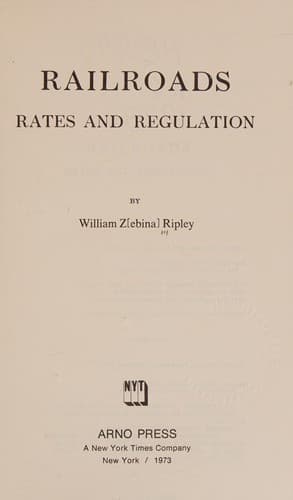
Railroads: Rates and RegulationsRipley, William Zebina
History
Railroads: Rates and Regulations
Ripley, William Zebina
Railroads -- Freight -- Rates -- United States; Railroads and state -- United States
For years attempts have been unsuccessfully made by accountants to
effect the primary separation between expenses of passenger and freight
business,[46] in order to determine the cost of transportation per
unit in each case. Some companies like the Louisville & Nashville
and the Burlington system, still divide up the two, usually on the
basis of the engine mileage for each class of traffic. This may be
serviceable enough for comparisons of costs from year to year in the
same company, but it has no general value and it may, moreover, become
highly misleading. The most absurd conclusions may result. Thus at one
time it appeared from such data, compiled by the Interstate Commerce
Commission, that the New York Central, with five times the density of
traffic of the Illinois Central, was actually conducting its freight
business at a much higher cost per ton mile. Such inconsistencies
induced the Interstate Commerce Commission in 1894 to abandon the
attempt at any such primary separation of accounts.[47] It has since
been reattempted, in special cases, as by the Wisconsin Railroad
Commission in its notable "Two-cent Fare" decision in 1907, the
division being made according to a number of different criteria.[48]
But it is plain that a very large proportion--probably over half--of
the expenditures for freight and passenger business are entirely joint,
however distinct the revenues from each service may be. We have seen
that approximately two-thirds of the outgo is incurred on behalf of
the property as a whole. Certain expenses, to be sure, such as train
wages, coal consumption and the maintenance of rolling stock, are
readily divisible; but with respect to the maintenance of way and
structures--about forty per cent. of the total outgo--all guides fail.
Even in respect of the cost of rails, due to wear and tear of train
movement, we are quite at sea in the allocation of expenses. Freight
trains may indeed be four times as heavy as passenger trains; but, on
the other hand, they move at far slower speeds. And then, finally, how
about the large item of capital cost, the proportion of outgo for
fixed charges? This equals about twenty-seven per cent. of the total
expenditures for the United States as a whole. We may, of course,
divide these expenses arbitrarily on the basis of the relative gross
revenue from freight and passenger business respectively. And yet how
absurd it would be to attempt to allocate an expense of a million
dollars for the abolition of grade crossings in this way. As between
the New Haven road, with passenger and freight revenues about equal,
and a western road with only one-tenth of its income derived from
passengers, the apparent cost of freight business on the eastern road
would be absurdly reduced by any such process. The facts are plain.
So many expenditures are incurred indiscriminately on behalf of the
service as a whole--being an indispensable condition for operation
Public-domain text, read in full here on John Shaqi.
Reviews
Reviews
No reviews yet
Be the first to share your thoughts on this work.
Elsewhere in the archive
Join the Discussion
Join the discussion
Sign in to leave a comment or review.
Sign InorCreate an account