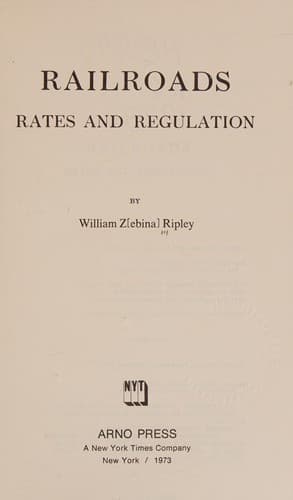
Railroads: Rates and RegulationsRipley, William Zebina
History
Railroads: Rates and Regulations
Ripley, William Zebina
Railroads -- Freight -- Rates -- United States; Railroads and state -- United States
An interesting comparison with the previous decade, 1870 to 1880,
exemplifies this relation still further. The gross earnings of the
trunk lines of the United States decreased very greatly per mile of
line from $7,211 in fact to $6,636 during the decade; but at the same
time the net earnings steadily increased. This was due primarily to the
great volume of business developed,--the ton mileage increasing more
than three fold during these ten years. It happened despite the fact
that the miles of line during the same period had more than doubled.
The following decade, 1880 to 1890, was represented by an increase of
only 82.7 per cent. in mileage, while the number of tons of freight
hauled one mile increased by 132 per cent. Density increasing in this
way, a corresponding ability to carry at a lower rate per ton was a
necessary result. So indisputably has this law--that an expanding
volume of business up to a certain point, may profitably be carried
at a continually lowered cost--been proved, that it is estimated by
so competent an authority as the _Engineering Review_ that, provided
sufficient tonnage be available for 2,000-ton freight train loads, a
cost of one mill per ton mile can be attained. Its significance may be
realized from the fact that the lowest revenue per ton mile reported
for the United States is 2.21 mills per ton mile for the long haul
soft coal business of the Chesapeake & Ohio.[58] This, of course, does
not imply that any railroad in actual operation, carrying all kinds
of freight including a large proportion of local traffic, can in the
immediate future hope to attain this result. It is intended only to
show that, provided the volume of traffic be large enough, the cost of
operation tends to decline as a matter of course, until a condition of
congestion for the existing plant has been reached. At this point a new
cycle of costs of operation and of profits makes its appearance.
Public-domain text, read in full here on John Shaqi.
Reviews
Reviews
No reviews yet
Be the first to share your thoughts on this work.
Elsewhere in the archive
Join the Discussion
Join the discussion
Sign in to leave a comment or review.
Sign InorCreate an account