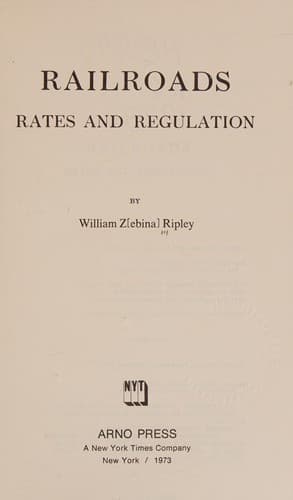
Railroads: Rates and RegulationsRipley, William Zebina
History
Railroads: Rates and Regulations
Ripley, William Zebina
Railroads -- Freight -- Rates -- United States; Railroads and state -- United States
On the other hand, the extravagant promises of economy from large
trainloads have been considerably abated of late. It has been
effectively demonstrated that there is a limit to such growth. Only
low-grade and long haul carload traffic can profitably be concentrated.
In 1903, for instance, a general decrease in trainloads followed a
reduction in the relative amounts of low as compared with high grade
tonnage. Less iron, coal, and raw materials and more merchandise and
manufactures offered for carriage, necessitated a positive reduction
in the trainloads as already mentioned. Nor can local business in
less than carload lots profitably be concentrated beyond a certain
point. Grades must be uniform to attain such economy. The trainload
must not exceed the traction power on the heaviest inclines, or else
expensive pusher engines or breaking up of trains will offset all other
savings. Moreover, too great trainloads even on the best roadbeds
involve slower speeds. Not only is other traffic thus impeded, but
the economy in wages vanishes after a certain point with such slower
movement. The fashion had been set by James J. Hill, the master mind
in the transcontinental field. His notable results, due to a careful
working out of every detail, led to a frenzied imitation on all sides.
Many roads then discovered to their loss that while they had provided
rolling stock for heavy loading, ampler terminals, longer sidings
and heavier bridges also were a necessary accompaniment. Part of the
congestion of traffic in 1906-1907, already mentioned, and a portion
of the financial embarrassments of recent years, were undoubtedly due
to too great haste in seeking economies of this sort in rolling stock,
without at the same time making provisions for enlargement of other
portions of the plant. A more discriminating policy has consequently
resulted of late. Traffic is being sorted according to its availability
for concentration. The best utilization of the rails and terminals is
being more considered. Business demands for quick delivery also enter
into the calculation. Instead of a few huge slow-moving leviathans
blocking other trains, the line may perhaps better be kept full of many
smaller trains moving more nearly together. Such are certain of the
details now being worked out. None of them, however, weaken the main
proposition that a discriminating concentration of traffic conduces
very greatly to economy of operation.
Public-domain text, read in full here on John Shaqi.
Reviews
Reviews
No reviews yet
Be the first to share your thoughts on this work.
Elsewhere in the archive
Join the Discussion
Join the discussion
Sign in to leave a comment or review.
Sign InorCreate an account