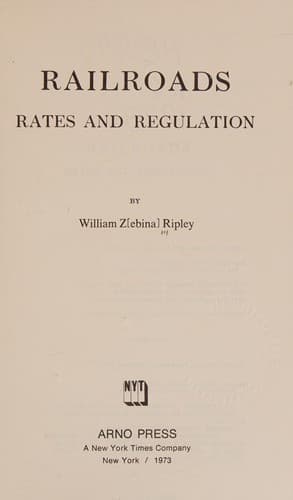
Railroads: Rates and RegulationsRipley, William Zebina
History
Railroads: Rates and Regulations
Ripley, William Zebina
Railroads -- Freight -- Rates -- United States; Railroads and state -- United States
Thus far the problem has been seemingly simple. The next step
introduces new complications. Our hypothetical railway line at a point
one hundred miles out, may cross a navigable river or canal, or may
intersect another railway. Engineering considerations of absolute cost
of operation now no longer predominate. Relative costs by rival lines
enter into the case. Water lines or more direct railways compete for
the traffic. One cannot even fall back upon the cost of carriage by
any of these lines, either the weaker or the stronger. An entirely
new principle comes into play. The alternative is presented of taking
the business at a rate lower than, and out of line with, rates on
general traffic, rather than to lose it to another line. At first
sight it would appear that it were better to abandon the traffic than
to take it for less than a fair average return or profit. This is a
serious matter. The tonnage offered is large. The existence of active
competition for it, is proof of its importance. Railways meet at large
towns, and large towns become larger because the roads meet there. The
main reason for not abandoning the traffic, however, arises from that
primary fact, to which one constantly recurs, that all expenses are not
alike in their nature. A concrete example will make this plain.
Suppose, for instance, the normal rate to yield a fair average return,
all expenses considered, be thirty cents per hundredweight. Two-thirds
of the cost of this, or twenty cents, would not cease as outgo, were
this business abandoned. The rails would rust, the ties would rot, and
trains would move but with lighter loads, and the fixed charges would
still go on inexorably night and day. Ten cents per hundredweight will
meet the variable and extra cost incident to this particular business.
A fifteen-cent rate would at least repay these extra outlays. It
would do more. It would contribute five cents per hundred pounds to
the twenty cents outgo per hundredweight, which, without the traffic,
would have to be borne _in toto_. Even a rate of eleven cents would
contribute something to this end. For it would leave a surplus of one
cent per hundredweight to lighten the other burden. Adopting Hadley's
phraseology,[67] if you take at eleven cents, freight that costs you
thirty cents to handle, you lose nineteen cents on every hundredweight.
If you refuse to take it at that rate, you lose twenty cents on every
hundredweight you do _not_ carry. For your constant expenses go on,
while the other road gets the business. There is only one course open.
The rate at the competitive point must be cut; if not to make a profit,
at least to stop a greater loss. And one comfort may be uncovered in
so doing. The lowered rate may so stimulate new business and enlarge
the volume of traffic, that it may be handled at much lower cost. In
fact, this consideration alone in absence of all competition, may
induce a lowering of rates at certain points out of line with the
general schedule.
Public-domain text, read in full here on John Shaqi.
Reviews
Reviews
No reviews yet
Be the first to share your thoughts on this work.
Elsewhere in the archive
Join the Discussion
Join the discussion
Sign in to leave a comment or review.
Sign InorCreate an account