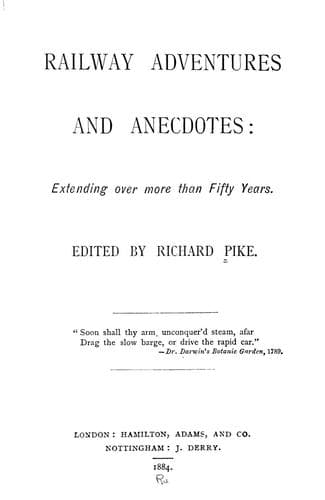
Railway Adventures and Anecdotes: Extending over More Than Fifty Years
History
Railway Adventures and Anecdotes: Extending over More Than Fifty Years
Railroads
Never had there occurred, in the history of joint-stock enterprise, such
another day as the 30th of November, 1845. It was the day on which a
madness for speculation arrived at its height, to be followed by a
collapse terrible to many thousand families. Railways had been gradually
becoming successful, and the old companies had, in many cases, bought
off, on very high terms, rival lines which threatened to interfere with
their profits. Both of these circumstances tended to encourage the
concoction of new schemes. There is always floating capital in England
waiting for profitable employment; there are always professional men
looking out for employment in great engineering works; and there are
always scheming moneyless men ready to trade on the folly of others.
Thus the bankers and capitalists were willing to supply the capital; the
engineers, surveyors, architects, contractors, builders, solicitors,
barristers, and Parliamentary agents were willing to supply the brains
and fingers; while, too often, cunning schemers pulled the strings. This
was especially the case in 1845, when plans for new railways were brought
forward literally by hundreds, and with a recklessness perfectly
marvellous.
By an enactment in force at that time, it was necessary, for the
prosecution of any railway scheme in Parliament, that a mass of documents
should be deposited with the Board of Trade, on or before the 30th of
November in the preceding year. The multitude of these schemes in 1845
was so great that there could not be found surveyors enough to prepare
the plans and sections in time. Advertisements were inserted in the
newspapers offering enormous pay for even a smattering of this kind of
skill. Surveyors and architects from abroad were attracted to England;
young men at home were tempted to break the articles into which they had
entered with their masters; and others were seduced from various
professions into that of railway engineers. Sixty persons in the
employment of the Ordnance Department left their situations to gain
enormous earnings in this way. There were desperate fights in various
parts of England between property-owners who were determined that their
land should not be entered upon for the purpose of railway surveying, and
surveyors who knew that the schemes of their companies would be
frustrated unless the surveys were made and the plans deposited by the
30th of November. To attain this end, force, fraud, and bribery were
freely made use of. The 30th of November, 1845, fell on a Sunday; but it
was no Sunday at the office near the Board of Trade. Vehicles were
driving up during the whole of the day, with agents and clerks bringing
plans and sections. In country districts, as the day approached, and on
the morning of the day, coaches-and-four were in greater request than
even at race-time, galloping at full speed to the nearest railway
station. On the Great Western Railway an express train was hired by the
agents of one new scheme.
Public-domain text, read in full here on John Shaqi.
Reviews
Reviews
No reviews yet
Be the first to share your thoughts on this work.
Elsewhere in the archive
Join the Discussion
Join the discussion
Sign in to leave a comment or review.
Sign InorCreate an account