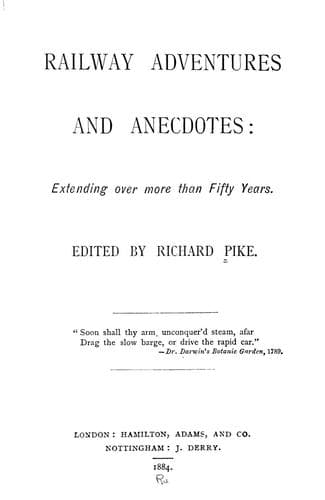
Railway Adventures and Anecdotes: Extending over More Than Fifty Years
History
Railway Adventures and Anecdotes: Extending over More Than Fifty Years
Railroads
The trouble which is bestowed by railway companies to cause the
restitution of lost property is incalculable. Some years ago, a young
lady lost a portmanteau from the rest of her luggage—a pardonable
oversight, for she was a bride starting on a honeymoon trip. The
bridegroom—never on such occasions an accountable being—had not noticed
the misfortune. When the loss was discovered, and application made
respecting it, the lady spoke positively of having seen it at the station
whence they started, then again at a station where they had to change
carriages; she saw it also when they left the railway; it was all safe,
she averred, at the hotel where they stopped for a few days. She was
also certain that it was among the rest of the “things” when they again
started for a watering-place; but, when they arrived there, it was
missing. It contained a new riding habit, value fifteen pounds. The
search that was instituted for this portmanteau recalled that of
Telemachus for Ulysses; the railway officials sent one of their clerks
with a _carte blanche_ to trace the bride’s journey to the end of the
last mile, till some tidings of the strayed trunk could be traced. He
went to every station, to every coach-office in connection with every
station, to every town, to every hotel, and to every lodging that the
happy couple had visited. His expenses actually amounted to fifteen
pounds. He came back without success. At length the treasure was found;
but where? At the by-station on another line, whence the bride had
started from home a maiden. Yet she had positively declared, without
doubt or reservation, that she had, “with her own eyes,” seen the trunk
on the various stages of her tour; this can only be accounted for by the
peculiar flustration of a young lady just plunged into the vortex of
matrimony. The husband paid the whole of the costs.
THIRD-CLASS PASSENGERS.
The conveyance of passengers at cheap fares was from the commencement of
railways a great public concern, and it was soon found necessary that the
legislature should take action in the matter. Accordingly, by the
Regulation of Railways Act, 1844, all passenger railways were required to
run one train every day from end to end of their line, carrying
third-class passengers at a rate not exceeding one penny a mile, stopping
at all stations, starting at hours approved by the Board of Trade,
travelling at least twelve miles an hour, and with carriages protected
from weather. This enactment greatly encouraged the poorer classes in
railway travelling; but the companies were slow to carry out the new
regulations cheerfully. The trains were timed at most inconvenient
hours; to undertake a journey of any considerable length in one day at
third-class fare was almost out of the question. In fact, a
short-sighted policy of doing almost everything to discourage third-class
travelling was adopted by the Companies.
Public-domain text, read in full here on John Shaqi.
Reviews
Reviews
No reviews yet
Be the first to share your thoughts on this work.
Elsewhere in the archive
Join the Discussion
Join the discussion
Sign in to leave a comment or review.
Sign InorCreate an account