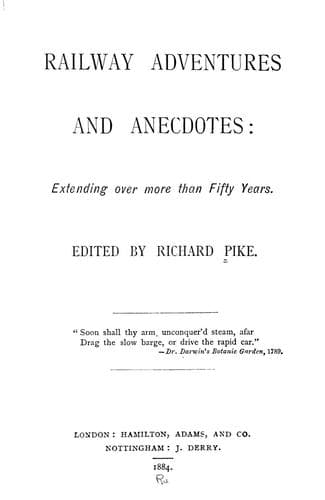
Railway Adventures and Anecdotes: Extending over More Than Fifty Years
History
Railway Adventures and Anecdotes: Extending over More Than Fifty Years
Railroads
to do it with divers companies who had nothing to do with each other but
to find fault and be jealous.
“On Mr. Edmonson’s machines may be seen the name of Blaycock; Blaycock
was a watchmaker, and an acquaintance of Edmonson’s, and a man whom he
knew to be capable of working out his idea. He told him what he wanted;
and Blaycock understood him, and realized his thought. The third machine
that they made was nearly as good as those now in use. The one we saw
had scarcely wanted five shillings worth of repairs in five years; and,
when it needs more, it will be from sheer wearing away of the brass-work,
by constant hard friction. The Manchester and Leeds Railway Company were
the first to avail themselves of Mr. Edmonson’s invention; and they
secured his services at their station at Oldham Road, for a time. He
took out a patent; and his invention became so widely known and
appreciated, that he soon withdrew himself from all other engagements, to
perfect its details and provide tickets to meet the daily growing demand.
He let out his patent on profitable terms—ten shillings per mile per
annum; that is, a railway of thirty miles long paid him fifteen pounds a
year for a license to print its own tickets by his apparatus; and a
railway of sixty miles long paid him thirty pounds, and so on. As his
profits began to come in, he began to spend them; and it is not the least
interesting part of his history to see how. It has been told that he was
a bankrupt early in life. The very first use he made of his money was to
pay every shilling that he ever owed. Ho was forty-six when he took that
walk in the field in Northumberland. He was fifty-eight when he died, on
the twenty-second of June last year.”
TAKEN ABACK.
Four young cavalry officers, travelling by rail, from Boulogne to Paris,
were joined at Amiens by a quiet, elderly gentleman, who shortly
requested that a little of one window might be opened—a not unreasonable
demand, as both were shut, and all four gentlemen were smoking. But it
was refused, and again refused on being preferred a second time, very
civilly; whereupon the elderly gentleman put his umbrella through the
glass. “Shall we stand the impertinence of this bourgeois?” said the
officers to one another. “Never.” And they thrust four cards into his
hand, which he received methodically, and looked carefully at all four;
producing his own, one of which he tendered to each officer with a bow.
Imagine their feelings when they read on each—“Marshal Randon, Ministre
de Guerre.”
FAITHFUL UNTO DEATH.
Public-domain text, read in full here on John Shaqi.
Reviews
Reviews
No reviews yet
Be the first to share your thoughts on this work.
Elsewhere in the archive
Join the Discussion
Join the discussion
Sign in to leave a comment or review.
Sign InorCreate an account