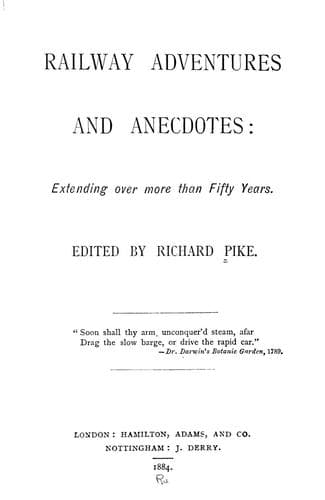
Railway Adventures and Anecdotes: Extending over More Than Fifty Years
History
Railway Adventures and Anecdotes: Extending over More Than Fifty Years
Railroads
But one of the most difficult things in the world is the levity with
which people talk about “obtaining information.” As if information were
as easy to pick up as stones! “It ain’t so hard to nuss the sick,” said
a hired nurse, “as some people might think; the most of ’em doesn’t want
nothing, and them as does doesn’t get it.” Parodying this, one might
say, it is much harder to “obtain information” than some people think;
the most don’t know anything, and those who do don’t say what they know.
Here is a real episode from the history of an inquiry, which took place
four or five years ago, into the desirability of making a new line of
railway on the Border. A witness was giving what is called “traffic
evidence,” in justification of the alleged need of the railway, and this
is what occurred:—
_Mr. Brown_ (the cross-examining counsel for the opponents of the new
line)—Do you mean to tell the committee that you ever saw an inhabited
house in that valley?
_Witness_—Yes I do.
_Mr. Brown_—Did you ever see a vehicle there in your life?
_Witness_—Yes, I did.
_Mr. Brown_—Very good.
Some other questions were put, which led to nothing particular: but, just
as the witness—a Scotchman—was leaving the box, the learned gentleman put
one more question:—
_Q_.—I am instructed to ask you, if the vehicle you saw was not the
hearse of the last inhabitant?
_Answer_—It was.
—_Cornhill Magazine_.
THE GOAT AND THE RAILWAY.
In Prussian Poland the goods and cattle trains are prohibited from
carrying passengers under any conditions, and, however urgent their
necessities, the only exception allowed being the herd-keepers in charge
of cattle. So strictly is this regulation enforced that even medical men
are not allowed to go by them when called for on an emergency, and where
life and death may be the result of their quick transit. This is
generally considered a great hardship, the more so as there are only two
passenger trains daily on the above railroads. But the inventive genius
of a small German innkeeper at Lissa has hit upon a clever plan of
circumventing the government regulations in a perfectly legitimate
manner. He keeps a goat, which he hires out to persons wanting to
proceed in a hurry by a cattle train, at the rate of 6d. per station, the
passenger then applying for a ticket as the person in charge of the goat,
which he obtains without any difficulty. In this manner a well-known
nobleman, residing at Lissa, is frequently seen travelling by the cattle
train to Posen, in the passenger’s carriage, and the goat is so tame that
a very slender silk ribbon suffices to keep it from straying.
THE FIRST RAILWAY IN THE CRIMEA.
Public-domain text, read in full here on John Shaqi.
Reviews
Reviews
No reviews yet
Be the first to share your thoughts on this work.
Elsewhere in the archive
Join the Discussion
Join the discussion
Sign in to leave a comment or review.
Sign InorCreate an account