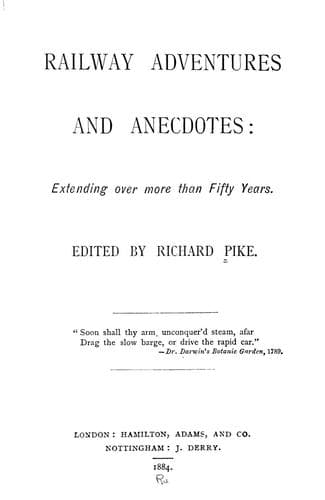
Railway Adventures and Anecdotes: Extending over More Than Fifty Years
History
Railway Adventures and Anecdotes: Extending over More Than Fifty Years
Railroads
Every item shipped by us for the works was valued before shipment at its
selling price; and for all these items of valuation, as well as for the
payments which we made for labour, we received the certificate of the
most eminent engineer of the day (the late lamented Mr. Robert
Stephenson). We undertook the execution of the Balaclava Railway as a
‘National’ work, agreeing to execute it without profit. We performed our
contract to the letter. We never profited by it to the extent of a
single shilling.
The works (nearly seven miles of railway) were executed in less than a
month; an incredibly short space of time, considering the season of the
year, the severity of the climate, and the difficulties to which,
considering the distance from home, we were all of us exposed. It is a
matter of history that they eventuated in the taking of the great
fortress of Sebastopol. Before the railway was made, all the shot, all
the shell, and all the ammunition necessary for the siege, had to be
carried from Balaclava to the camp, a distance of five miles up hill,
through mud and sludge, upon the backs of the soldiers. An immense
proportion of our troops was told off for this most laborious service; of
whom no less than 25 per cent per month perished in its execution. On
the day the railway was opened, it carried to the camp of the British
army, in 24 hours, more shot and shell than had been brought from
Balaclava for six weeks previously.
To our principal agent in the Crimea, the late Mr. Beattie, the greatest
credit was due for the way in which the arrangements were made, and the
work executed on that side. Mr. Beattie’s labours were so arduous, and
his efforts so untiring, that he died of fatigue within six weeks after
the completion of the work—a victim, absolutely, to his unparalleled
exertions. The only favour in connection with these works which the Duke
of Newcastle ever granted at our request, he granted to the family of
this lamented gentleman. Mr. Beattie left a widow and four children to
deplore his loss, and through the favour of the Duke of Newcastle, the
widow, who now resides with her father, an estimable clergyman in the
North of Ireland, enjoys a pension as the widow of a colonel falling in
the field.”
PASSENGERS AND OTHER CATTLE.
At the Eastern Counties meeting (1854) the solicitor cut short a clause
about passengers, animals, and cattle, by reading it “passengers and
other cattle.” We do not recollect passengers having been classed with
cattle before. Perhaps the learned gentleman’s eyesight was defective,
or the print was not very clear.
EXPANSION OF RAILS.
Public-domain text, read in full here on John Shaqi.
Reviews
Reviews
No reviews yet
Be the first to share your thoughts on this work.
Elsewhere in the archive
Join the Discussion
Join the discussion
Sign in to leave a comment or review.
Sign InorCreate an account