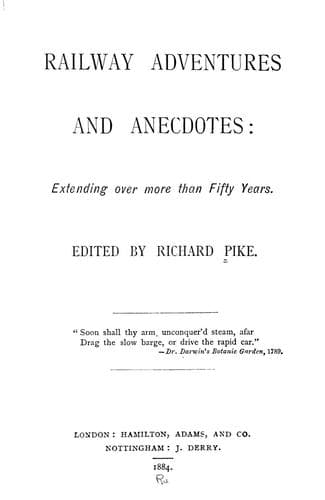
Railway Adventures and Anecdotes: Extending over More Than Fifty Years
History
Railway Adventures and Anecdotes: Extending over More Than Fifty Years
Railroads
“Mr. Leopold Redpath passed in society as a gentleman of ample means,
great taste, and possessed of the Christian virtue of charity in no
common degree. He had a house in Chester Terrace, handsomely furnished,
and a “place” at Weybridge complete with every luxury that wealth could
procure; gave good dinners with excellent wines; kept good horses and
neat carriages. He was a governor of Christ’s Hospital, the St. Ann’s
Schools, and subscribed freely to the most useful charities of London.
His appointment on the Great-Northern was worth £300 per annum; but it
was supposed that this was only of consequence to Mr. Redpath as
affording him a regular occupation and an opportunity of operating in the
share-market, in which he was known to have extensive dealings. The
directors of the railway appear to have been perfectly aware that their
servant was living far beyond his salary, but they considered him to be a
very successful speculator. Upon this splendid bubble being blown up,
Redpath fled to Paris; but, finding that the French authorities were not
inclined to protect him, he returned to London and surrendered himself.
“The mode in which this gigantic swindler had committed his frauds is
simple enough. Having charge of the books in which the stock of the
company is registered, he altered the sum standing in the name of some
_bonâ fide_ stockholder to a much larger sum, generally by placing a
figure before it, by which simple means £500 became £1,500, or £2,500, or
any larger number of thousands. The surplus stock thus _created_ Redpath
sold in the stock-market, forging the name of the supposed transferer,
transferring the sum to the account of the supposed transferee in the
register, and either attesting it himself, or causing it to be attested
by a young man, his protegé and tool, but who appears to have been free
from guilty cognizance. In some instances the fraud was but the more
direct course of making a fictitious entry of stock, and then selling it.
By these processes the number of shareholders and the amount of stock on
the company’s register became greatly magnified, while, as the _bonâ
fide_ holders of stock remained credited with their proper investments,
there was no occasion for suspicion on their part. How Redpath dealt
with subsequent transfers of the fictitious stock does not appear. The
prisoner was subjected to repeated examination before the police
magistrates, when this prodigious falsification was thoroughly sifted,
and the prisoner was finally committed for trial at the Central Criminal
Court in the following year. It is said that the value of the leases,
furniture, and articles of taste in Redpath’s house in Chester Terrace is
estimated at £30,000, and at Weybridge at a still larger sum. It is also
said that Redpath and Robson, whose forged transfer of Crystal Palace
shares has been recorded in this chronicle, were formerly fellow clerks.
Public-domain text, read in full here on John Shaqi.
Reviews
Reviews
No reviews yet
Be the first to share your thoughts on this work.
Elsewhere in the archive
Join the Discussion
Join the discussion
Sign in to leave a comment or review.
Sign InorCreate an account