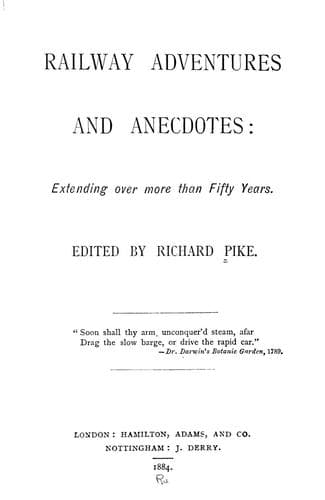
Railway Adventures and Anecdotes: Extending over More Than Fifty Years
History
Railway Adventures and Anecdotes: Extending over More Than Fifty Years
Railroads
Of course, travelling in Russia is no longer what it was. During the
last quarter of a century a vast network of railways has been constructed
and one can now travel in a comfortable first-class carriage from Berlin
to St. Petersburg or Moscow, and thence to Odessa, Sebastopol, the Lower
Volga, or even the foot of the Caucasus; and, on the whole, it must be
admitted that the railways are tolerably comfortable. The carriages are
decidedly better than in England, and in winter they are kept warm by
small iron stoves, such as we sometimes see in steamers, assisted by
double windows and double doors—a very necessary precaution in a land
where the thermometer often descends to 30 degrees below zero. The
trains never attain, it is true, a high rate of speed—so at least English
and Americans think—but then we must remember that Russians are rarely in
a hurry, and like to have frequent opportunities of eating and drinking.
In Russia time is not money; if it were, nearly all the subjects of the
Tsar would always have a large stock of ready money on hand, and would
often have great difficulty in spending it. In reality, be it
parenthetically remarked, a Russian with a superabundance of ready money
is a phenomenon rarely met with in real life.
In conveying passengers at the rate of from fifteen to thirty miles an
hour, the railway companies do at least all that they promise, but in one
very important respect they do not always strictly fulfil their
engagements. The traveller takes a ticket for a certain town, and on
arriving at what he imagines to be his destination, he may merely find a
railway station surrounded by fields. On making inquiries he finds to
his disappointment, that the station is by no means identical with the
town bearing the same name, and that the railway has fallen several miles
short of fulfilling the bargain, as he understood the terms of the
contract. Indeed, it might almost be said as a general rule railways in
Russia, like camel drivers in certain Eastern countries, studiously avoid
the towns. This seems at first a strange fact. It is possible to
conceive that the Bedouin is so enamoured of tent life and nomadic
habits, that he shuns a town as he would a man-trap; but surely civil
engineers and railway contractors have no such dread of brick and mortar.
The true reason, I suspect, is that land within or immediately without
the municipal barrier is relatively dear, and that the railways, being
completely beyond the invigorating influence of healthy competition, can
afford to look upon the comfort and convenience of passengers as a
secondary consideration.
Public-domain text, read in full here on John Shaqi.
Reviews
Reviews
No reviews yet
Be the first to share your thoughts on this work.
Elsewhere in the archive
Join the Discussion
Join the discussion
Sign in to leave a comment or review.
Sign InorCreate an account