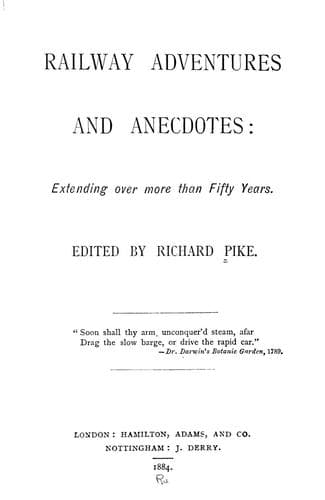
Railway Adventures and Anecdotes: Extending over More Than Fifty Years
History
Railway Adventures and Anecdotes: Extending over More Than Fifty Years
Railroads
CONVERSION OF THE GAUGE.
The conversion of the gauge on the South Wales section of the Great
Western railway in 1872 was of the heaviest description, the period of
labour lasting from seventeen to eighteen hours a day for several
successive days. It was the greatest work of its kind, and nothing
exactly like it will ever be done in England again. The lines of rail to
be connected would have made about 400 miles in single length, the number
of men employed was about 1500; and the time taken was two weeks nearly.
Oatmeal and barley water was made into a thin gruel and given to the men
as required. It was the only drink taken during the day. I had not a
single case of drunkenness or illness. I have often heard these men
speak with great approbation of the supporting power of oatmeal drink.
—_J. W. Armstrong_, _C.E._
FOURTH-OF-JULY FACTS.
At a banquet in Paris attended by Americans in celebration of the late
Fourth of July, Mr. Walker’s speech in reply to the toast of the material
prosperity of the United States and France, and the establishment of
closer commercial relations between them, was especially striking and
interesting. He remarked, “In 1870 the cost of transporting food and
merchandise between the Western and Eastern States was from a
cent-and-a-half to two cents a ton a mile. I well remember a
conversation which I had in 1870 or 1871 with Mr. William B. Ogden, of
Chicago, one of the modest railway kings of that primitive period. In a
vein of sanguine prophecy, Mr. Ogden exclaimed to me, ‘Mr. Walker, you
will live to see freight brought from Chicago to New York at a cent a ton
a mile!’ ‘Perhaps so,’ I replied; ‘but I fear this result will not be
reached in my time.’ In 1877 or 1878 the cost had fallen to
three-eighths of a cent a ton a mile, and although this price was not
remunerative, I was told by one of the highest authorities in railway
matters that five-eighths of a cent would be perfectly satisfactory. The
effect of this reduction in the cost of transportation is precisely as
though the unexhaustible grain fields and pastures across the Mississippi
had been moved bodily eastward to the longitude of Ohio and Western New
York. It is estimated that it takes a quarter of a ton of bread and meat
to feed a grown man in Massachusetts for a year. The bread and meat come
to him from the far west, and I have no doubt that it will astonish you
to be told, as it lately astonished me, that a single day of this man’s
labour, even if it be of the commonest sort, will pay for transporting
his year’s subsistence for a thousand miles.”
TAY BRIDGE ACCIDENT.
Public-domain text, read in full here on John Shaqi.
Reviews
Reviews
No reviews yet
Be the first to share your thoughts on this work.
Elsewhere in the archive
Join the Discussion
Join the discussion
Sign in to leave a comment or review.
Sign InorCreate an account