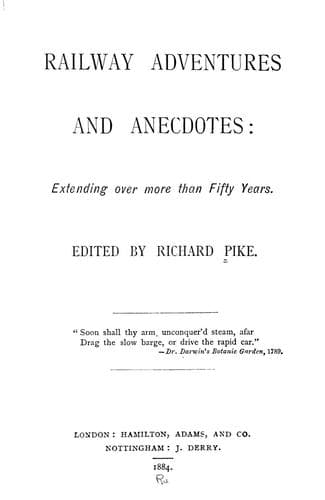
Railway Adventures and Anecdotes: Extending over More Than Fifty Years
History
Railway Adventures and Anecdotes: Extending over More Than Fifty Years
Railroads
An engineer on a locomotive going across the western prairie day after
day, saw a little child come out in front of a cabin and wave to him, so
he got in the habit of waving back to the child, and it was the day’s joy
to see this little one come out in front of the cabin door and wave to
him while he answered back. One day the train was belated, and it came
on to the dusk of the evening. As the engineer stood at his post he saw
by the headlight that little girl on the track, wondering why the train
did not come, looking for the train, knowing nothing of her peril. A
great horror seized upon the engineer. He reversed the engine. He gave
it in charge of the other man, and then he climbed over the engine, and
he came down on the cowcatcher. He said though he had reversed the
engine, it seemed as though it were going at lightning speed, faster and
faster, though it was really slowing up, and with almost supernatural
clutch he caught the child by the hair and lifted it up, and when the
train stopped, and the passengers gathered around to see what was the
matter, there the old engineer lay, fainted dead away, the little child
alive and in his swarthy arms.
FEMALE FRAGILITY.
There was a time when American women prided themselves on their
fragility. To be healthy, strong or plump was thought to be the height
of vulgarity, and refinement was held to be inseparable from leanness and
consumption. These views still obtain—so it is said—in Boston, and
especially in Bostonian literary circles; but elsewhere the American
woman is growing plump and healthy, and is actually proud of it. While
wise men are heartily glad of this change in female sentiment and tissue,
it must be admitted that there is one form of feminine fragility which
has its value. There is a rare condition of the bony system in which the
bones are so fragile that the slightest blow is sufficient to break them.
A baby thus afflicted cannot be handled, even by the most experienced
mother, without danger; and a man with fragile bones is so liable to be
broken, that there is sometimes no safety for him outside of a glass
case. The late Mrs. Baker—for that was her latest name—was not so
fragile that she could not be handled by a careful man, but still a very
light blow would usually break her. She did not share the Bostonian
opinion of the vulgarity of strength, but she was, nevertheless, very
proud of her fragility, and by its aid her husband managed to amass a
comfortable fortune within three years after their marriage. She is
perhaps the only fragile woman on record of whom it can be said that her
whole value consisted in her fragility, but, as her story shows, her
fragility was the sole capital invested in her husband’s business. In
January, 1870, Mrs. Baker—then a single woman, as to whose maiden name
there is some uncertainty—was married to Mr. Wheelwright—James G.
Wheelwright, of Worcester, Mass. Her husband married her on account of
Public-domain text, read in full here on John Shaqi.
Reviews
Reviews
No reviews yet
Be the first to share your thoughts on this work.
Elsewhere in the archive
Join the Discussion
Join the discussion
Sign in to leave a comment or review.
Sign InorCreate an account