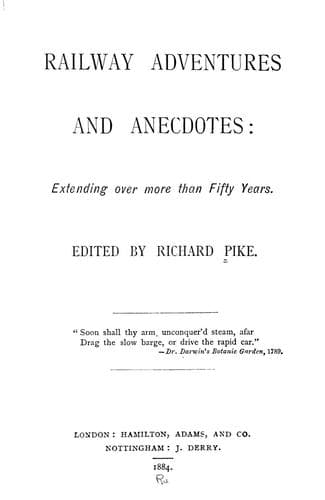
Railway Adventures and Anecdotes: Extending over More Than Fifty Years
History
Railway Adventures and Anecdotes: Extending over More Than Fifty Years
Railroads
The suit of William O’Connor against the Boston and Lowell Railroad at
Lawrence has resulted in a verdict for the plaintiff in $10,000, one-half
the amount sued for. This suit grew out of an accident which occurred
August 27th, 1880. The plaintiff was the father of a child then between
five and six years old. He and his brother, three years older, were
crossing a private way maintained by the railroad for the Essex Company,
and the younger boy, while walking backward, stepped between the rail and
planking of the roadway inside and was unable to extricate his foot. At
that moment the whistle of a train was heard within a few hundred feet
and out of sight around a curve, and it appeared from the evidence that
the older brother, finding himself unable to relieve his brother, ran
down the track toward the train; but finding that he could not attract
the attention of the trainmen to his brother’s condition, and that he
must be run over, ran back to him, and, telling him to lie down, pulled
him outward and down and held him there until the train had passed. Both
feet of the little fellow were cut off or mangled so that amputation was
necessary. The theory of the defence was that the boy was not caught,
but while running across the track, fell and was run over. But the
testimony of the older brother was unshaken in every particular. It
would be difficult to match the nerve, thoughtfulness, and disregard of
self displayed by this boy, who at that time was less than nine years
old.
PHOTOGRAPHING AN EXPRESS TRAIN.
An interesting application of the instantaneous method of photography was
recently made by a firm of photographers at Henley-on-Thames. These
artists were successful in photographing the Great Western Railway
express train familiarly known as the “Flying Dutchman,” while running
through Twyford station at a speed of nearly sixty miles an hour. The
definition of this lightning-like picture is truly wonderful, the details
of the mechanism on the flying locomotive standing out as sharply as the
immovable telegraph posts and palings beside the line. The photographers
are now engaged, we believe, in constructing a swift shutter for their
camera which will reduce the period of exposure of the photographic plate
to 1-500th of a second. The same artists have also executed some
charming pictures of the upper Thames, with floating swans and moving
boats, which cannot but win the admiration of artists and all lovers of
the picturesque.
—_Cassell’s Family Magazine_, Nov. 1880.
NERVOUSNESS.
Public-domain text, read in full here on John Shaqi.
Reviews
Reviews
No reviews yet
Be the first to share your thoughts on this work.
Elsewhere in the archive
Join the Discussion
Join the discussion
Sign in to leave a comment or review.
Sign InorCreate an account