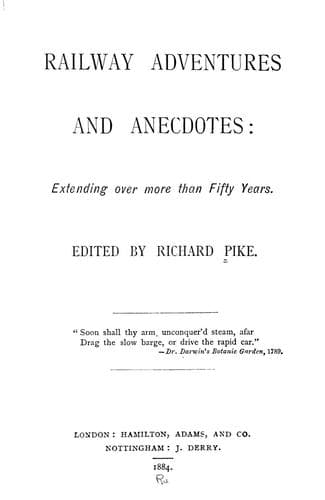
Railway Adventures and Anecdotes: Extending over More Than Fifty Years
History
Railway Adventures and Anecdotes: Extending over More Than Fifty Years
Railroads
“On one occasion,” we are told, “travelling alone in a railway carriage,
he fell asleep with his feet resting on the window-sill. As usual, he
kicked off his boots, and they fell outside the carriage on the line.
When he reached his destination the boots could not, of course, be found,
and he had to go without them to his hotel. The next morning a
platelayer, examining the permanent way, came upon the boots, and
reported to the traffic manager that he had found a pair of gentleman’s
boots, but that he could not find the gentleman. Some one connected with
the railway recollected that Mr. Buckland had been seen in the
neighbourhood, and, knowing his eccentricities, inferred that the boots
must belong to him. They were accordingly sent to the Home Office, and
were at once claimed.”
DRINKING FROM THE WRONG BOTTLE.
An incident has occurred on one of the suburban lines which will
certainly be supposed by many to be only _ben trovato_, but it is a real
fact. A lady, who seemed perfectly well before the train entered a
tunnel, suddenly alarmed her fellow-passengers during the temporary
darkness by exclaiming, “I am poisoned!” On re-emerging into daylight,
an awkward explanation ensued. The lady carried with her two bottles,
one of methylated spirit, the other of cognac. Wishing, presumably, for
a refresher on the sly, she took advantage of the gloom; but she applied
the wrong bottle to her lips. Time pressed, and she took a good drain.
The consequence was she was nearly poisoned, and had to apply herself
honestly and openly to the brandy bottle as a corrective, amidst the
ironical condolence of the passengers she had previously alarmed.
—_Once a Week_.
HORSES VERSUS RAILWAYS.
A horse for every mile of road was the allowance made by the best
coachmasters on the great routes. On the corresponding portions of the
railway system the great companies have put a locomotive engine per mile.
If a horse earned a hundred guineas a year, out of which his cost had to
be defrayed, he did well. A single locomotive on the Great Northern
Railway (and that company has 611 engines for 659 miles of line) was
stated by John Robinson, in 1873, to perform the work of 678 horses—work,
that is, as measured by resistance overcome; for the horses, whatever
their number, could not have reached the speed of fifty miles an hour, at
which the engines in questions whirled along a train of sixteen
carriages, weighing in all 225 tons. There are now upwards of 13,000
locomotives at work in the United Kingdom, each of them earning on the
average, £4,750 per annum. But we have at the same time more horses
employed for the conveyance of passengers than we had in 1835. In
omnibus and station work—waiting upon the steam horse—there is more
demand for horseflesh than was made by our entire coaching system in
1835.
A SLIGHT MISTAKE.
Public-domain text, read in full here on John Shaqi.
Reviews
Reviews
No reviews yet
Be the first to share your thoughts on this work.
Elsewhere in the archive
Join the Discussion
Join the discussion
Sign in to leave a comment or review.
Sign InorCreate an account