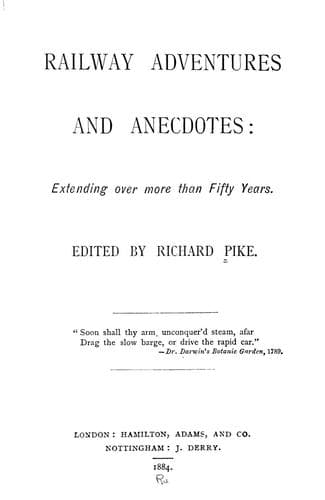
Railway Adventures and Anecdotes: Extending over More Than Fifty Years
History
Railway Adventures and Anecdotes: Extending over More Than Fifty Years
Railroads
“He _was_ complimenting you, sir, to some tune, and asking, as a souvenir
of his happy engagement under the Great Brassey, that you would of your
goodness make him a present of the shop, iron, tools, and all belonging!”
“Did he, though! I did not understand that.”
“No sir, but you kept on saying, ‘Oui, oui, oui,’ and the fellow’s
delighted, as he well may be, they’re worth £50 or £60.”
“Oh, but I didn’t mean that, I didn’t mean that. Well, never mind, if I
said it, he must _have_ them.”
It must be borne in mind, that at that time, at best, Mr. Brassey knew
very little French, and his staff were well aware of the fact.”
Sep. 13, 1872.
S. S.
EXTRAORDINARY ACCIDENT.
In a leading article in the _Birmingham Post_, Nov. 12th, 1880, the
writer remarks:—“The report of Major Marindin on the collision which took
place between two Midland trains, in Leicestershire, about a month ago,
has just been published, but it adds nothing to the information given at
the time when the accident happened. The case was, as the report says,
one of a remarkable, if not unprecedented nature, for the collision arose
from a passenger train running backwards instead of forwards nearly
half-a-mile, without either driver or stoker noticing that its movement
was in the wrong direction. Shortly after the train had passed the
village station of Kibworth, where it was not timed to stop, the driver
observed a knocking sound on his engine. He pulled up the train in order
to ascertain the cause of this, and finding that nothing serious was the
matter, proceeded on his journey again, or rather intended to do so, for,
by an extraordinary mistake, he turned the screw the wrong way, so as to
reverse the action of the engine, and to direct the train back to
Kibworth. There, a mineral train was making its way towards Leicester,
and as the line was on a sharp incline the result might have been a most
destructive collision. It was, however, reduced to one of a
comparatively mild description by the promptness and efficiency with
which the brakes were applied to both the trains. Had not the mineral
train been pulled up, and the passenger train lowered from a speed of
twenty to three or four miles an hour, probably the whole of the
passengers would have been crushed between the two engines. The
passengers, therefore, owed their safety to the excellent brake-power
which was at command. The excuse offered by the driver of the passenger
train for turning the engine backwards was the shape of the reversing
screw, which was of a construction not commonly used on the Midland line,
though many of the company’s engines were so fitted. The fireman had
also his apology for making the same oversight. He said he was at the
time stooping down to adjust the injector. Major Marindin, though
admitting that the men were experienced, careful, and sober, refuses to
Public-domain text, read in full here on John Shaqi.
Reviews
Reviews
No reviews yet
Be the first to share your thoughts on this work.
Elsewhere in the archive
Join the Discussion
Join the discussion
Sign in to leave a comment or review.
Sign InorCreate an account