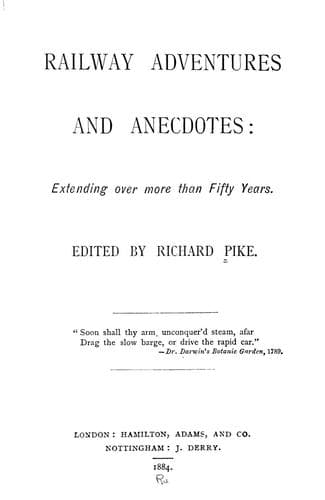
Railway Adventures and Anecdotes: Extending over More Than Fifty Years
History
Railway Adventures and Anecdotes: Extending over More Than Fifty Years
Railroads
fellow-creature thus struck down by our side, and the breathless
thankfulness for our own preservation, rendered the first evening of our
party at Heaton almost solemn; but the next day the occurrence became a
subject of earnest, it is true, but free discussion; and after that was
alluded to with almost as little apparent feeling as if it had not passed
under our eyes, and within the space of a few hours.”
MRS. BLACKBURNE’S PRESENTIMENT.
Miss Kemble was mistaken in stating Mr. Huskisson after his accident was
removed to Manchester. He was conveyed to the vicarage, at Eccles, near
Manchester. Of the vicar’s wife, Dean Stanley’s mother thus writes,
(January 17, 1832,):—“There is one person who interests me very much,
Mrs. Tom Blackburne, the Vicaress of Eccles, who received poor Mr.
Huskisson, and immortalised herself by her activity, sense, and conduct
throughout.” A writer in the _Cornhill Magazine_, for March, 1884,
referring to the opening of the Liverpool and Manchester Railway,
remarks:—“In celebration of this experiment, for even then most people
only looked upon it as a doubtful thing, the houses of the adjacent parts
of Lancashire were filled with guests. Mr. John Blackburne, M.P., asked
his brother and sister-in-law, Mr. and Mrs. Thomas Blackburne, to stay at
Hale Hall, near Liverpool, (which his ancestors in the direct line had
possessed since 1199,) and to go with his party to the ceremony and fetes
of the day.
The invitation was accepted, and Mr. and Mrs. Blackburne went to Hale.
Now, however, occurred one of those strange circumstances utterly
condemned by critics of fiction as ‘unreal,’ ‘unnatural,’ or
‘impossible;’ only in this case it happened to be true, in spite of all
these epithets. Mrs. Blackburne, rather strong-minded than otherwise, at
all events one of the last women in the world to be affected by
imagination, became possessed by an unmistakable presentiment, which made
her feel quite sure _that her presence was required at home_; _and she
went home at once_. There were difficulties in her way; every carriage
was required, but she would go. She drove to Warrington, and from thence
‘took boat’ up the Irwell to Eccles. Canal boats were then regular
conveyances, divided into first and second classes. There were no mobs
or excitement anywhere on the 14th, and Mrs. Blackburne got quickly to
Eccles without any adventures. When there, except that one of her
children was unwell, she could find nothing wrong, or in the least likely
to account for the presentiment which had driven her home in spite of all
the natural enough, ridicule of her husband and friends at Hale.
Public-domain text, read in full here on John Shaqi.
Reviews
Reviews
No reviews yet
Be the first to share your thoughts on this work.
Join the Discussion
Join the discussion
Sign in to leave a comment or review.
Sign InorCreate an account