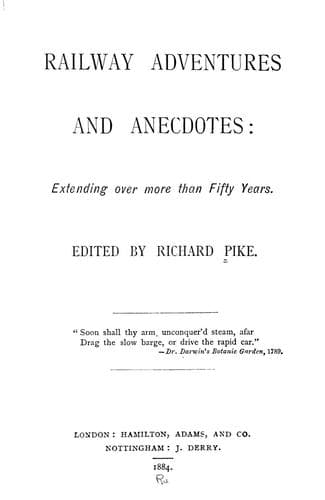
Railway Adventures and Anecdotes: Extending over More Than Fifty Years
History
Railway Adventures and Anecdotes: Extending over More Than Fifty Years
Railroads
Early on the morning of the 15th, an incident occurred, the narration of
which may throw some light on the temper of the times. Mr. Barton, of
Swinton, came to say that a mob was expected to come from Oldham to
attack the Duke of Wellington, then at the height of his unpopularity
among the masses; for just by Eccles three miles of the line was left
unguarded, ‘Could Mr. Blackburne say what was to be done?’
‘My husband is away,’ said the Vicaress, ‘but I know that about fifty
special constables were out last year, the very men for this work, if
their licenses have not expired.’
‘Never mind licenses,’ replied Mr. Barton, with a superb indifference to
form, quite natural under the circumstances. ‘Where can I find the men?’
‘Oh,’ replied Mrs. Blackburne, ‘I can get the men for you.’
Mr. Barton hesitated, but soon with gratitude accepted the offer, and
with the help of the churchwardens and constables ‘a guard for the Duke’
was soon collected on the bridge of Eccles, armed with staves and clubs
to be dispersed along the line.
This done, she had a tent put up for herself and children, with whom were
Lord Wilton’s little daughters, the Ladies Elizabeth and Katherine
Egerton, and their governess. The tent was just above the cutting and
looked down on to it, and they would have a good view of the first train,
expected to pass about eleven o’clock. The morning wore on, the crowds
were increasing, and low murmurs of wonder were heard. It was thought
that the experiment had failed. A few of the villagers came into the
field, but none troubled the little band of watchers. The bright
sunshine had passed away, and it had become dark, with large hot drops of
rain, forerunners of a coming thunderstorm. The people lined the whole
of the way from Manchester to Liverpool, and, as far as the eye could
reach, faces were seen anxiously looking towards Liverpool. Suddenly a
strange roar was heard from the crowd, not a cheer of triumph, but a
prolonged wail, beginning at the furthest point of travelling along the
swarming banks like the incoming swirl of a breaker as it runs upon a
gravelled beach.
Like a true woman, her first thought was for her husband, as Mrs.
Blackburne heard the words repeated on all sides, ‘An accident!’ ‘The
Vicarage!’ She flew across the field to the gate and met a sad
procession bringing in a sorely-wounded yet quite conscious man. She saw
in a moment that he had medals on his coat, and had been very tall, so
that it could not be as she feared. The relief of that moment may be
imagined. Then the quiet presence of mind, by practice habitual to her,
and the ready flow of sympathy left her no time to think of anything but
the sufferer, who said to her pathetically, ‘I shall not trouble you
long!’ She had not only the will but the power to help, even to
supplying from her own medicine chest and stores, kept for the poor,
everything that the surgeons required.
Public-domain text, read in full here on John Shaqi.
Reviews
Reviews
No reviews yet
Be the first to share your thoughts on this work.
Join the Discussion
Join the discussion
Sign in to leave a comment or review.
Sign InorCreate an account