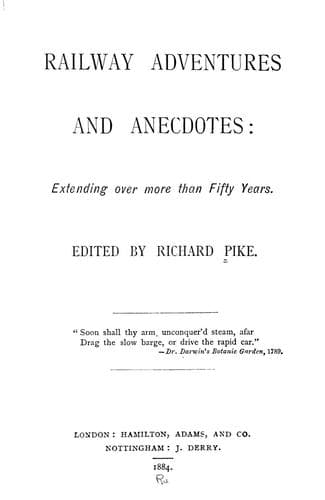
Railway Adventures and Anecdotes: Extending over More Than Fifty Years
History
Railway Adventures and Anecdotes: Extending over More Than Fifty Years
Railroads
“Nor is the rapid passage across Chat Moss unworthy of notice. The
ingenuity with which two narrow rods of iron are made to bear whole
trains of wagons, laden with many hundred tons of commerce, and bounding
across a wide, semi-fluid morass, previously impassable by man or beast,
is beyond all praise and deserving of eternal record. Only conceive a
slender bridge of two minute iron rails, several miles in length, level
as Waterloo, elastic as whalebone, yet firm as adamant! Along this
splendid triumph of human genius—this veritable _via triumphalis_—the
train of carriages bounds with the velocity of the stricken deer; the
vibrations of the resilient moss causing the ponderous engine and its
enormous suite to glide along the surface of an extensive quagmire as
safely as a practiced skater skims the icy mirror of a frozen lake.
“The first class or train is the most fashionable, but the second or
third are the most amusing. I travelled one day from Liverpool to
Manchester in the lumber train. Many of the carriages were occupied by
the swinish multitude, and others by a multitude of swine. These last
were naturally vociferous if not eloquent. It is evident that the other
passengers would have been considerably annoyed by the orators of this
last group, had there not been stationed in each carriage an officer
somewhat analogous to the Usher of the Black Rod, but whose designation
on the railroad I found to be ‘Comptroller of the Gammon.’ No sooner did
one of the long-faced gentlemen raise his note too high, or wag his jaw
too long, than the ‘Comptroller of the Gammon’ gave him a whack over the
snout with the butt end of his shillelagh; a snubber which never failed
to stop his oratory for the remainder of the journey.”
To one familiar with the history of railroad legislation the last
paragraph is peculiarly significant. For years after the railroad system
was inaugurated, and until legislation was invoked to compel something
better, the companies persisted in carrying passengers of the third class
in uncovered carriages, exposed to all weather, and with no more
decencies or comforts than were accorded to swine.
EARLY RAILWAY TRAVELLING.
A writer in _Notes and Queries_ remarks:—“On looking over a diary kept by
my father during two journeys northward in 1830–31, I thought the readers
might be amused with his account of what he saw of railway travelling,
then in its infancy:—
Public-domain text, read in full here on John Shaqi.
Reviews
Reviews
No reviews yet
Be the first to share your thoughts on this work.
Elsewhere in the archive
Join the Discussion
Join the discussion
Sign in to leave a comment or review.
Sign InorCreate an account