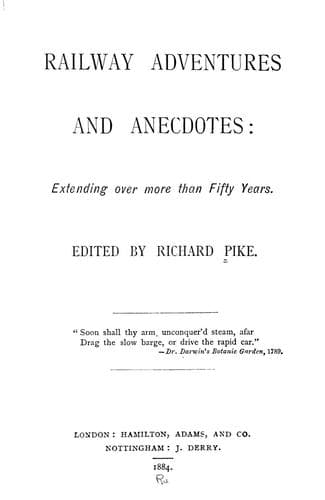
Railway Adventures and Anecdotes: Extending over More Than Fifty Years
History
Railway Adventures and Anecdotes: Extending over More Than Fifty Years
Railroads
“Monday, Sept. 12, 1831.—Left Manchester by coach at ten o’clock, and
arrived in Liverpool at half-past two. . . The railroad is not supposed
to answer vastly well, but they are making a branch to Warrington, which
will hurt the Sankey Navigation, and throw 1,500 men out of employment;
these people are said to be loud in their execrations of it, and to
threaten revenge. It is certain the proprietors do not all feel easy
about it, as one living at Warrington has determined never to go by it,
and was coming to Liverpool by our coach if there had been room. He
would gladly sell his shares. A dividend of 4 per cent. had been paid
for six months, but money had been borrowed. . . . Charge for tonnage of
goods, 10s. for thirty-two miles, which appears very dear to me.”
CRABB ROBINSON’S FIRST RAILWAY JOURNEY.
“June 9th, 1833.—(Liverpool). At twelve o’clock I got upon an omnibus,
and was driven up a steep hill to the place where the steam carriages
start. We travelled in the second class of carriages. There were five
carriages linked together, in each of which were placed open seats for
the travellers, four or five facing each other; but not all were full;
and, besides, there was a close carriage, and also a machine for luggage.
The fare was four shillings for the thirty-one miles. Everything went on
so rapidly that I had scarcely the power of observation. The road begins
at an excavation through a rock, and is to a certain extent insulated
from the adjacent country. It is occasionally placed on bridges, and
frequently intersected by ordinary roads. Not quite a perfect level is
preserved. On setting off there is a slight jolt, arising from the chain
catching each carriage, but, once in motion, we proceeded as smoothly as
possible. For a minute or two the pace is gentle, and is constantly
varying. The machine produces little smoke or steam. First in order is
the tall chimney; then the boiler, a barrel-like vessel; then an oblong
reservoir of water; then a vehicle for coals; and then comes, of a length
infinitely extendible, the train of carriages. If all the seats had been
filled, our train would have carried about 150 passengers; but a
gentleman assured me at Chester that he went with a thousand persons to
Newton fair. There must have been two engines then. I have heard since
that two thousand persons or more went to and from the fair that day.
But two thousand only, at three shillings each way, would have produced
£600! But, after all, the expense is so great that it is considered
uncertain whether the establishment will ultimately remunerate the
proprietors. Yet I have heard that it already yields the shareholders a
dividend of nine per cent. And Bills have passed for making railroads
between London and Birmingham, and Birmingham and Liverpool. What a
change it will produce in the intercourse! One conveyance will take
between 100 and 200 passengers, and the journey will be made in a
Public-domain text, read in full here on John Shaqi.
Reviews
Reviews
No reviews yet
Be the first to share your thoughts on this work.
Elsewhere in the archive
Join the Discussion
Join the discussion
Sign in to leave a comment or review.
Sign InorCreate an account