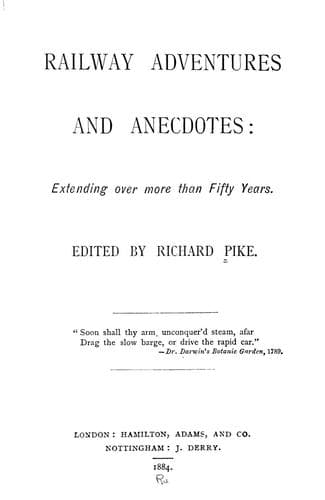
Railway Adventures and Anecdotes: Extending over More Than Fifty Years
History
Railway Adventures and Anecdotes: Extending over More Than Fifty Years
Railroads
forenoon! Of the rapidity of the journey I had better experience on my
return; but I may say now that, stoppages included, it may certainly be
made at the rate of twenty miles an hour.
“I should have observed before that the most remarkable movements of the
journey are those in which trains pass one another. The rapidity is such
that there is no recognizing the features of a traveller. On several
occasions, the noise of the passing engine was like the whizzing of a
rocket. Guards are stationed in the road, holding flags, to give notice
to the drivers when to stop. Near Newton I noticed an inscription
recording the memorable death of Huskisson.”
—_Crabb Robinson’s Diary_.
EARLY AMERICAN RAILWAY ENTERPRISE.
Mr. C. F. Adams, in his work on _Railroads_: _Their Origin and Problems_,
remarks:—“There is, indeed, some reason for believing that the South
Carolina Railroad was the first ever constructed in any country with a
definite plan of operating it exclusively by locomotive steam power. But
in America there was not—indeed, from the very circumstances of the case,
there could not have been—any such dramatic occasions and surprises as
those witnessed at Liverpool in 1829 and 1830. Nevertheless, the people
of Charleston were pressing close on the heels of those at Liverpool, for
on the 15th of January, 1831—exactly four months after the formal opening
of the Manchester and Liverpool road—the first anniversary of the South
Carolina Railroad was celebrated with due honor. A queer-looking
machine, the outline of which was sufficient in itself to prove that the
inventor owed nothing to Stephenson, had been constructed at the West
Point Foundry Works in New York during the summer of 1830—a first attempt
to supply that locomotive power which the Board had, with sublime
confidence in possibilities, unanimously voted on the 14th of the
preceding January should alone be used on the road. The name of _Best
Friend_ was given to this very simple product of native genius. The idea
of the multitubular boiler had not yet suggested itself in America. The
_Best Friend_, therefore, was supplied with a common vertical boiler, ‘in
form of an old-fashioned porter-bottle, the furnace at the bottom
surrounded with water, and all filled inside of what we call teats
running out from the sides and tops.’ By means of the projections or
‘teats’ a portion at least of the necessary heating surface was provided.
The cylinder was at the front of the platform, the rear end of which was
occupied by the boiler, and it was fed by means of a connecting pipe.
Thanks to the indefatigable researches of an enthusiast on railroad
construction, we have an account of the performances of this and all the
other pioneers among American locomotives, and the pictures with which
Mr. W. H. Brown has enriched his book would alone render it both curious
and valuable. Prior to the stockholders’ anniversary of January 15th,
Public-domain text, read in full here on John Shaqi.
Reviews
Reviews
No reviews yet
Be the first to share your thoughts on this work.
Elsewhere in the archive
Join the Discussion
Join the discussion
Sign in to leave a comment or review.
Sign InorCreate an account