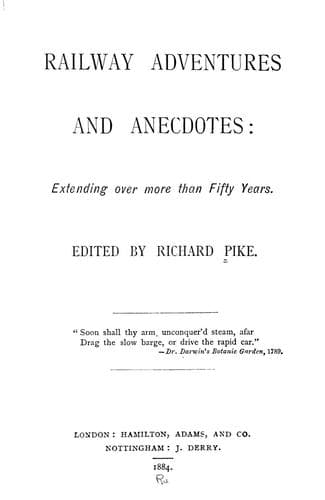
Railway Adventures and Anecdotes: Extending over More Than Fifty Years
History
Railway Adventures and Anecdotes: Extending over More Than Fifty Years
Railroads
Shortly after telegraphs were laid alongside of railways, a principal
officer of a railway company got into a compartment of a stopping train
at an intermediate station. The train had hardly left, when an elderly
gentleman, in terms of endearment, invited what turned out to be a little
Skye terrier to come out of its concealment under the seat. The dog came
out, jumped up, and appeared to enjoy his journey until the speed of the
train slackened previous to stopping at a station, the dog then
instinctively retreated to its hiding place, and came out again in due
course after the train had started. The officer of the company left the
train at a station or two afterwards. On its arrival at the London
ticket platform the gentleman delivered up the tickets for his party.
“Dog ticket, sir, please.” “Dog ticket, what dog ticket?” “Ticket, sir,
for Skye terrier, black and tan, with his ears nearly over his eyes;
travelling, for comfort’s sake, under the seat opposite to you, sir, in a
large carpet bag, red ground with yellow cross-bars.” The gentleman
found resistance useless; he paid the fare demanded, when the
ticket-collector—who throughout the scene had never changed a
muscle—handed him a ticket that he had prepared beforehand. “Dog ticket,
sir; gentlemen not allowed to travel with a dog without a dog ticket; you
will have to give it up in London.” “Yes, but how did you know I had a
dog? That’s what puzzles me!” “Ah, sir,” said the ticket-collector,
relaxing a little, but with an air of satisfaction, “the telegraph is
laid on our railway. Them’s the wires you see on the outside; we find
them very useful in our business, etc. Thank you, sir, good morning.”
It is needless to tell what part the principal officer played in this
little drama. On arrival in London the dog ticket was duly claimed, a
little word to that effect having been sent up by a previous train to be
sure to have it demanded, although, as a usual practice, dog tickets are
collected at the same time as those of passengers.
—_Roney’s Rambles on Railways_.
THE ELECTRIC CONSTABLE.
The first application of the telegraph to police purposes took place in
1844, on the Great Western Railway, and, as it was the first intimation
thieves got of the electric constable being on duty, it is full of
interest. The following extracts are from the telegraph book kept at the
Paddington Station:—
“Eton Montem Day, August 28, 1844.—The Commissioners of Police having
issued orders that several officers of the detective force shall be
stationed at Paddington to watch the movements of suspicious persons,
going by the down train, and give notice by the electric telegraph to the
Slough station of the number of such suspected persons, and dress, their
names (if known), also the carriages in which they are.”
Public-domain text, read in full here on John Shaqi.
Reviews
Reviews
No reviews yet
Be the first to share your thoughts on this work.
Elsewhere in the archive
Join the Discussion
Join the discussion
Sign in to leave a comment or review.
Sign InorCreate an account