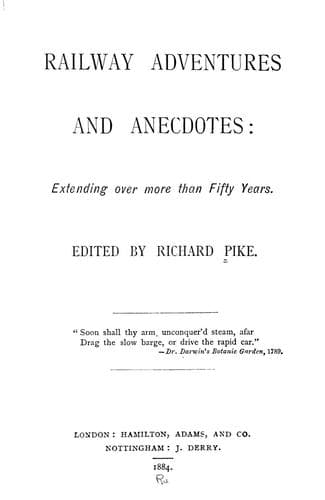
Railway Adventures and Anecdotes: Extending over More Than Fifty Years
History
Railway Adventures and Anecdotes: Extending over More Than Fifty Years
Railroads
Mr. Williams in his book, _Our Iron Roads_, gives an account of a foolish
act of signalling to stop a train; he says:—“An Irishman, who appears to
have been in some measure acquainted with the science of signalling, was
on one occasion walking along the Great Western line without permission,
when he thought he might reduce his information to practical use.
Accordingly, on seeing an express train approach, he ran a short distance
up the side of the cutting, and began to wave a handkerchief very
energetically, which he had secured to a stick, as a signal to stop. The
warning was not to be disregarded, and never was command obeyed with
greater alacrity. The works of the engine were reversed—the tender and
van breaks were applied—and soon, to the alarm of the passengers, the
train came to a ‘dead halt.’ A hundred heads were thrust out of the
carriage windows, and the guard had scarcely time to exclaim, ‘What’s the
matter?’ when Paddy, with a knowing touch of his ‘brinks,’ asked his
‘honour if he would give him a bit of a ride?’ So polite and ingenuous a
request was not to be denied, and, though biting his lips with annoyance,
the officer replied ‘Oh, certainly; jump in here,’ and the pilgrim was
ensconced in the luggage van. But instead of having his ride ‘for his
thanks,’ the functionary duly handed him over to the magisterial
authorities, that he might be taught the important lesson, that railway
companies did not keep express trains for Irish beggars, and that such
costly machinery was not to be imperilled with impunity, either by their
freaks or their ignorance.”
STEAM WHISTLE.
In the early days of railways, the signal of alarm was given by the
blowing of a horn. In the year, 1833, an accident occurred on the
Leicester and Swannington railway near Thornton, at a level crossing,
through an engine running against a horse and cart. Mr. Bagster, the
manager, after narrating the circumstance to George Stephenson, asked “Is
it not possible to have a whistle fitted on the engine, which the steam
can blow?” “A very good thought,” replied Stephenson. “You go to Mr.
So-and-So, a musical instrument maker, and get a model made, and we will
have a steam whistle, and put it on the next engine that comes on the
line.” When the model was made it was sent to the Newcastle factory and
future engines had the whistle fitted on them.
EXEMPTION FROM ACCIDENTS.
Public-domain text, read in full here on John Shaqi.
Reviews
Reviews
No reviews yet
Be the first to share your thoughts on this work.
Elsewhere in the archive
Join the Discussion
Join the discussion
Sign in to leave a comment or review.
Sign InorCreate an account