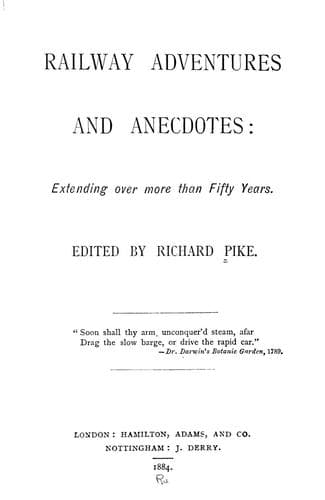
Railway Adventures and Anecdotes: Extending over More Than Fifty Years
History
Railway Adventures and Anecdotes: Extending over More Than Fifty Years
Railroads
Amongst laughable occurrences that enlivened the committee rooms during
the gauge contest, was a scene occasioned by a parliamentary counsel
putting in as evidence, before the committee on the Southampton and
Manchester line, a printed picture of troubles consequent on a break of
gauge. The picture was a forcible sketch that had appeared a few days
before in the pages of the _Illustrated London News_. Opposing counsel
of course argued against the production of the work of art as testimony
for the consideration of the committee. After much argument on both
sides the chairman decided in favour of receiving the illustration, which
was forthwith put, amidst much laughter, into the hands of a witness, who
was asked if it was a fair picture of the evils that arose from a break
of gauge. The witness replying in the affirmative, the engraving was
then laid before the committee for inspection.
—_Railway Chronicle_, June 13, 1846.
EXTRAORDINARY USE OF THE ELECTRIC TELEGRAPH.
Oct. 7, 1847. An extraordinary instance has occurred of the application
of the electric telegraph at the London Bridge terminus of the South
Eastern Railway.
Hutchings, the man found guilty and sentenced to death for poisoning his
wife, was to have been executed at Maidstone Goal at twelve o’clock.
Shortly before the appointed hour for carrying the sentence into effect,
a message was received at the London Bridge terminus, from the Home
Office, requesting that an order should be sent by the electric telegraph
instructing the Under-Sheriff at Maidstone to stay the execution two
hours. By the agency of the electric telegraph the communication was
received in Maidstone with the usual rapidity, and the execution was for
a time stayed. Shortly after the transmission of the order deferring the
execution, a messenger from the Home Office conveyed to the railway the
Secretary of State’s order, that the law was to take its course, and that
the culprit was to be at once executed. The telegraph clerk hesitated to
sending such a message without instructions from his principals. The
messenger from the Home Office could not be certain that the order for
Hutchings’s execution was signed by the Home Secretary, although it bore
his name; and Mr. Macgregor, the chairman, with great judgment and
humanity, instantly decided that it was not a sufficient authority in
such a momentous matter.
Public-domain text, read in full here on John Shaqi.
Reviews
Reviews
No reviews yet
Be the first to share your thoughts on this work.
Elsewhere in the archive
Join the Discussion
Join the discussion
Sign in to leave a comment or review.
Sign InorCreate an account