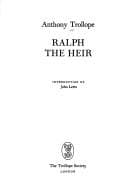
Domestic fiction; England -- Fiction; Fathers and sons -- Fiction; Inheritance and succession -- Fiction
"That's quite true, Sir Thomas," said Ralph, in a loud ringing tone,
which seemed to imply that let things be as bad as they might he
did not mean to make a poor mouth of them. It was his mask for the
occasion, and it sufficed to hide his misery from Sir Thomas.
"If you think of selling what you have to sell," continued Sir
Thomas, "you had better take Mr. Newton's letter and put it into the
hands of your own attorney. It will be ten times better than going
to the money-lending companies for advances. If I had the means of
helping you myself, I would do it."
"Oh, Sir Thomas!"
"But I have not. I should be robbing my own girls, which I am sure
you would not wish."
"That is quite out of the question, Sir Thomas."
"If you do resolve on selling the estate, you had better come to me
as the thing goes on. I can't do much, but I may perhaps be able to
see that nothing improper is proposed for you to do. Goodbye, Ralph.
Anything will be better than marrying that what-d'ye-callem's
daughter."
Ralph, as he walked westwards towards the club, was by no means sure
that Sir Thomas had been right in this. By marrying Polly he would,
after all, keep the property.
Just by the lions in Trafalgar Square he met Ontario Moggs. Ontario
Moggs scowled at him, and cut him dead.
CHAPTER XIV.
THE REV. GREGORY NEWTON.
It was quite at the end of July, in the very hottest days of a very
hot summer, that Squire Newton left Newton Priory for London, intent
upon law business, and filled with ambition to purchase the right
of leaving his own estate to any heir whom he might himself select.
He left his son alone at the Priory; but his son and the parson
were sure to be together on such an occasion. Ralph,--the country
Ralph,--dined at the Rectory on the day that his father started; and
on every succeeding day, Gregory, the parson, dined up at the large
house. It was a thing altogether understood at the Priory that the
present parson Gregory was altogether exempted from the anathema
which had been pronounced against the heir and against the memory
of the heir's father. Gregory simply filled the place which might
have been his had there been no crushing entail, and was, moreover,
so sweet and gentle-hearted a fellow that it was impossible not
to love him. He was a tall, slender man, somewhat narrow-chested,
bright-eyed, with a kind-looking sweet mouth, a small well-cut nose,
dark but not black hair, and a dimple on his chin. He always went
with his hands in his pockets, walking quick, but shuffling sometimes
in step as though with hesitation, stooping somewhat, absent
occasionally, going about with his chin stuck out before him, as
though he were seeking something,--he knew not what. A more generous
fellow, who delighted more in giving, hesitated more in asking, more
averse to begging though a friend of beggars, less self-arrogant, or
self-seeking, or more devoted to his profession, never lived. He was
Public-domain text, read in full here on John Shaqi.
Reviews
Reviews
No reviews yet
Be the first to share your thoughts on this work.
Elsewhere in the archive
Join the Discussion
Join the discussion
Sign in to leave a comment or review.
Sign InorCreate an account