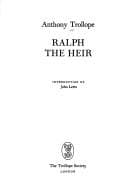
Domestic fiction; England -- Fiction; Fathers and sons -- Fiction; Inheritance and succession -- Fiction
The two men were sitting on the lawn at the Priory after dinner,
smoking cigars, and Ralph,--this other Ralph,--had just told the
parson of his intention of joining his father in London. "I don't see
that I can do any good," said Ralph, "but he wishes it, and of course
I shall go."
"You won't see my brother, I suppose?"
"I should think not. You know what my father's feelings are, and
I certainly shall not go out of my way to offend them. I have no
animosity against Ralph; but I could do no good by opposing my
father."
"No," said the parson, "not but what I wish it were otherwise. It is
a trouble to me that I cannot have Ralph here;--though perhaps he
would not care to come."
"I feel it hard too, that he should not be allowed to see a place
which, in a measure, belongs to him. I wish with all my heart that
my father did not think so much about the estate. Much as I love the
old place, I can hardly think about it without bitterness. Had my
father and your brother been on good terms together, there would
have been none of that. Nothing that he could do,--no success in his
efforts,--can make me be as I should have been had I been born his
heir. It is a misfortune, and of course one feels it; but I think I
should feel it less were he not so fixed in his purpose to undo what
can never be undone."
"He will never succeed," said Gregory.
"Probably not;--though, for that matter, I suppose Ralph will be
driven to raise money on his inheritance."
"He will never sell the property."
"It seems that he does spend money faster than he can get it."
"He may have done so."
"Is he not always in debt to you yourself? Is he not now thinking
of marrying some tradesman's daughter to relieve him of his
embarrassments? We have to own, I suppose, that Master Ralph has made
a mess of his money matters?" The parson, who couldn't deny the fact,
hardly knew what to say on his brother's behalf. "I protest to you,
Greg, that if my father were to tell me that he had changed his mind,
and paid your brother's debts out of sheer kindness and uncleship,
and the rest of it, I should be well pleased. But he won't do that,
and it does seem to me probable that the estate will get into the
hands of Jews, financiers, and professional money-dealers, unless my
father can save it. You wouldn't be glad to see some shopkeeper's
daughter calling herself Mrs. Newton of Newton."
"A shopkeeper's daughter need not necessarily be a--a--a bad sort of
woman," said Gregory.
"The chances are that a shopkeeper's daughter will not be an educated
lady. Come, Greg;--you cannot say that it is the kind of way out of
the mess you would approve."
"I am so sorry that there should be any mess at all!"
Public-domain text, read in full here on John Shaqi.
Reviews
Reviews
No reviews yet
Be the first to share your thoughts on this work.
Elsewhere in the archive
Join the Discussion
Join the discussion
Sign in to leave a comment or review.
Sign InorCreate an account