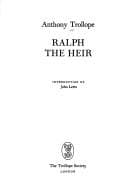
Domestic fiction; England -- Fiction; Fathers and sons -- Fiction; Inheritance and succession -- Fiction
The one great sorrow of his life, the thorn in the flesh which was
always festering, the wound which would not be cured, the grief for
which there was no remedy, was his love for Clarissa Underwood. He
had asked her thrice to be his wife,--with very little interval,
indeed, between the separate prayers,--and had been so answered that
he entertained no hope. Had there been any faintest expectation in
his mind that Clarissa would at last become his wife he would have
been deterred by a sense of duty from making to his brother that
generous offer of all the property he owned. But he had no such hope.
Clarissa had given thrice that answer, which of all answers is the
most grievous to the true-hearted lover. "She felt for him unbounded
esteem, and would always regard him as a friend." A short decided
negative, or a doubtful no, or even an indignant repulse, may
be changed,--may give way to second convictions, or to better
acquaintance, or to altered circumstances, or even simply to
perseverance. But an assurance of esteem and friendship means, and
only can mean, that the lady regards her lover as she might do some
old uncle or patriarchal family connection, whom, after a fashion,
she loves, but who can never be to her the one creature to be
worshipped above all others.
Such were Gregory Newton's ideas as to his own chance of success,
and, so believing, he had resolved that he would never press his
suit again. He endeavoured to conquer his love;--but that he found
to be impossible. He thought that it was so impossible that he had
determined to give up the endeavour. Though he would have advised
others that by God's mercy all sorrows in this world could be cured,
he told himself,--without arraigning God's mercy,--that for him this
sorrow could not be cured. He did not scruple, therefore, to assure
his brother that he would not marry,--nor did he hesitate, in writing
to Patience Underwood, to assure her that his love for her sister was
unchangeable. In saying so he urged no suit;--but it was impossible
that he should write to the house without some message, and none
other from him to her could be a true message. It could not hurt
her. It would not even give her the trouble to think whether she
had decided well. He quite understood the nature of the love he
wanted,--a love that would have felt it to be all happiness to lean
upon his bosom. Without this love he would not have wished to take
her;--and with such love as that he knew he could not fill her heart.
Therefore it was that he would satisfy himself with walking round the
churchyard of Newton Peele, and telling himself that the pleasure of
this world was best to be found in the pursuit of the joys of the
next.
CHAPTER XV.
CLARISSA WAITS.
Public-domain text, read in full here on John Shaqi.
Reviews
Reviews
No reviews yet
Be the first to share your thoughts on this work.
Elsewhere in the archive
Join the Discussion
Join the discussion
Sign in to leave a comment or review.
Sign InorCreate an account