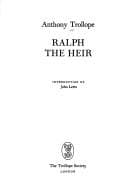
Domestic fiction; England -- Fiction; Fathers and sons -- Fiction; Inheritance and succession -- Fiction
"Oh yes, you do. Poor Ralph, our Ralph, is a spendthrift, and I
shouldn't wonder if this one were to have the property after all.
And then his father is very rich. I know that because Gregory told
me. Dear me! wouldn't it be odd if we were all three to become Mrs.
Newtons?"
"Clary, what did I tell you?"
"Well; I won't. But it would be odd,--and so nice, at least I think
so. Well;--I dare say I ought not to say it. But then I can't help
thinking it,--and surely I may tell you what I think."
"I would think it as little as I could, dear."
"Ah, that's very well. A girl can be a hypocrite if she pleases,
and perhaps she ought. Of course I shall be a hypocrite to all
the world except you. I tell you what it is, Patty;--you make me
tell you everything, and say that of course you and I are to tell
everything,--and then you scold me. Don't you want me to tell you
everything?"
"Indeed I do;--and I won't scold you. Dear Clary, do I scold you?
Wouldn't I give one of my eyes to make you happy?"
"That's quite a different thing," said Clarissa.
Three days afterwards Mr. Ralph Newton;--it is hoped that the reader
may understand the attempts which are made to designate the two young
men;--Mr. Ralph Newton appeared again at Popham Villa. He came in
almost with the gait of an old friend, and brought some fern leaves,
which he had already procured from Hampshire, in compliance with a
promise which he had made to Patience Underwood. "That's what we
call the hart's tongue," said he, "though I fancy they give them all
different names in different places."
"It's the same plant as ours, Mr. Newton,--only yours is larger."
"It's the ugliest of all the ferns," said Clary.
"Even that's a compliment," said Newton. "It's no use transplanting
them in this weather, but I'll send you a basket in October. You
should come down to Newton and see our ferns. We think we're very
pretty, but because we're so near, nobody comes to see us." Then he
fell a-talking with Mary Bonner, and stayed at the villa nearly all
the afternoon. For a moment or two he was alone with Clarissa, and at
once expressed his admiration. "I don't think I ever saw such perfect
beauty as your cousin's," he said.
"She is handsome."
"And then she is so fair, whereas everybody expects to see dark eyes
and black hair come from the West Indies."
"But Mary wasn't born there."
"That doesn't matter. The mind doesn't travel back as far as that.
A negro should be black, and an American thin, and a French woman
should have her hair dragged up by the roots, and a German should be
broad-faced, and a Scotchman red-haired,--and a West Indian beauty
should be dark and languishing."
"I'll tell her you say so, and perhaps she'll have herself altered."
"Whatever you do, don't let her be altered," said Mr. Newton. "She
can't be changed for the better."
"I am quite sure he is over head and ears in love," said Clarissa to
Patience that evening.
CHAPTER XVI.
THE CHESHIRE CHEESE.
Public-domain text, read in full here on John Shaqi.
Reviews
Reviews
No reviews yet
Be the first to share your thoughts on this work.
Elsewhere in the archive
Join the Discussion
Join the discussion
Sign in to leave a comment or review.
Sign InorCreate an account