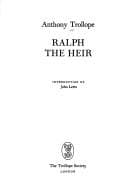
Domestic fiction; England -- Fiction; Fathers and sons -- Fiction; Inheritance and succession -- Fiction
Squire Newton was also up in London; and though London was never much
to his taste, he was in these days by no means so wretched as his
nephew. He was intent on a certain object, and he began to hope, nay
to think, that his object might be achieved. He had not once seen his
nephew, having declared his conviction very strongly that it would be
better for all parties that they should remain apart. His own lawyer
he saw frequently, and Ralph's lawyer once, and Sir Thomas more than
once or twice. There was considerable delay, but the Squire would
not leave London till something was, if not settled, at any rate
arranged, towards a settlement. And it was the expression of his will
conveyed through the two lawyers which kept Ralph in London. What was
the worth of Ralph's interest in the property? That was one great
question. Would Ralph sell that interest when the price was fixed?
That was the second question. Ralph, to whom the difficulty of giving
an answer was as a labour of Hercules, staved off the evil day for
awhile by declaring that he must know what was the price before he
could say whether he would sell the article. The exact price could
not be fixed. The lawyers combined in saying that the absolute sum
of money to include all Ralph's interest in the estate could not be
named that side of Christmas. It was not to be thought of that any
actuary, or valuer, or lawyer, or conveyancer, should dispose of
so great a matter by a month's work. But something approaching to
a settlement might be made. A sum might be named as a minimum. And
a compact might be made, subject to the arbitration of a sworn
appraiser. A sum was named. The matter was carried so far, that Ralph
was told that he could sign away all his rights by the middle of
September,--sign away the entire property,--and have his pockets
filled with ample funds for the Moonbeam, and all other delights. He
might pay off Moggs and Neefit, and no longer feel that Polly,--poor
dear Polly,--was a millstone round his neck. And he would indeed, in
this event, be so well provided, that he did not for a moment doubt
that, if he chose so to circumscribe himself, Clarissa Underwood
might be his wife. All the savings of the Squire's life would be
his,--enough, as the opposing lawyer told him with eager pressing
words, to give him an estate of over a thousand a year at once. "And
it may be more,--probably will be more," said the lawyer. But at the
very least a sum approaching to thirty thousand pounds would be paid
over to him at once. And he might do what he pleased with this. There
was still a remnant of his own paternal property sufficient to pay
his debts.
Public-domain text, read in full here on John Shaqi.
Reviews
Reviews
No reviews yet
Be the first to share your thoughts on this work.
Elsewhere in the archive
Join the Discussion
Join the discussion
Sign in to leave a comment or review.
Sign InorCreate an account