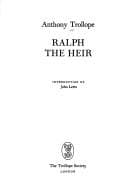
Domestic fiction; England -- Fiction; Fathers and sons -- Fiction; Inheritance and succession -- Fiction
On the first evening he said very little to his son. He felt that his
son did not quite sympathise with him, and he was sore that it should
be so. He could not be angry with his son. He knew well that this
want of sympathy arose from a conviction on this son's part that, let
what might be done in regard to the property, nothing could make him,
who was illegitimate, capable of holding the position in the country
which of right belonged to Newton of Newton. But the presence of this
feeling in the mind of the son was an accusation against himself
which was very grievous to him. Almost every act of his latter
life had been done with the object of removing the cause for such
accusation. To make his boy such as he would have been in every
respect had not his father sinned in his youth, had been the one
object of the father's life. And nobody gainsayed him in this but
that son himself. Nobody told him that all his bother about the
estate was of no avail. Nobody dared to tell him so. Parson Gregory,
in his letters to his brother, could express such an opinion. Sir
Thomas, sitting alone in his chamber, could feel it. Ralph, the
legitimate heir, with an assumed scorn, could declare to himself
that, let what might be sold, he would still be Newton of Newton. The
country people might know it, and the farmers might whisper it one
to another. But nobody said a word of this to the Squire. His own
lawyer never alluded to such a matter, though it was of course in his
thoughts. Nevertheless, the son, whom he loved so well, would tell
him from day to day,--indirectly, indeed, but with words that were
plain enough,--that the thing was not to be done. Men and women
called him Newton, because his father had chosen so to call him;--as
they would have called him Tomkins or Montmorenci, had he first
appeared before them with either of those names; but he was not a
Newton, and nothing could make him Newton of Newton Priory,--not even
the possession of the whole parish, and an habitation in the Priory
itself. "I wish you wouldn't think about it," the son would say to
the father;--and the expression of such a wish would contain the
whole accusation. What other son would express a desire that the
father would abstain from troubling himself to leave his estate
entire to his child?
On the morning after his return the necessary communication was made.
But it was not commenced in any set form. The two were out together,
as was usual with them, and were on the road which divided the two
parishes, Bostock from Newton. On the left of them was Walker's farm,
called the Brownriggs; and on the right, Darvell's farm, which was in
their own peculiar parish of Newton. "I was talking to Darvell while
you were away," said Ralph.
"What does he say for himself?"
"Nothing. It's the old story. He wants to stay, though he knows he'd
be better away."
"Then let him stay. Only I must have the place made fit to look at. A
man should have a chance of pulling through."
Public-domain text, read in full here on John Shaqi.
Reviews
Reviews
No reviews yet
Be the first to share your thoughts on this work.
Elsewhere in the archive
Join the Discussion
Join the discussion
Sign in to leave a comment or review.
Sign InorCreate an account