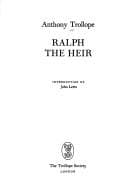
Domestic fiction; England -- Fiction; Fathers and sons -- Fiction; Inheritance and succession -- Fiction
"I think you are hard upon him, sir," said the son to the father.
"Of course you think so. At any rate you'll say so," said the Squire.
"One would suppose I was thinking only of myself to hear you talk."
"I know what you're thinking of," said Ralph slowly; "and I know how
much I owe you."
"I sometimes think that you ought to curse me," said the Squire.
After this, at this moment, with such words ringing in his ears,
Ralph found it to be impossible to expostulate with his father. He
could only take his father's arm, and whisper a soft feminine word or
two. He would be as happy as the day was long, if only he could see
his father happy.
"I can never be happy till I have placed you where you would have
been," said the Squire. "The gods are just, and our pleasant vices
make instruments to scourge us." He did not quote the line to
himself, but the purport of it hung heavy on him. And yet he thought
it hard that because he had money in his pocket he could not
altogether make himself free of the scourge.
On the following morning he was less vituperative and less
unreasonable, but he was still intent upon the subject. After
breakfast he got his son into his own room,--the room in which he did
his magistrate's work, and added up his accounts, and kept his spuds
and spurs,--and seriously discussed the whole matter. What would it
be wise that they should do next? "You don't mean to tell me that you
don't wish me to buy it?" said the Squire. No; Ralph would not say
that. If it were in the market, to be bought, and if the money were
forthcoming, of course such a purchase would be expedient. "The money
is forthcoming," said the Squire. "We can make it up one way or
another. What matter if we did sell Brownriggs? What matter if we
sold Brownriggs and Twining as well?" Ralph quite acceded to this.
As far as buying and selling were concerned he would have acceded
to anything that would have made his father happy. "I won't say a
word against this fellow, since you are so fond of him," continued
the Squire. Ralph, though his father paused, made no reply to the
intended sarcasm. "But you must allow that he had a reason for
writing such a letter as he did."
"Of course he had a reason," said Ralph.
"Well;--we'll say that he wants to keep it."
"That's not unnatural."
"Not at all. Everybody likes to keep what he's got, and to get as
much as he can. That's nature. But a man can't eat his cake and have
it. He has been slow to learn that, no doubt; but I suppose he has
learned it. He wouldn't have gone to Sir Thomas Underwood, in the
way he did, crying to be helped,--if he hadn't learned it. Remember,
Ralph, I didn't go to him first;--he came to me. You always forget
that. What was the meaning then of Sir Thomas writing to me in that
pitiful way,--asking me to do something for him;--and he who had I
don't know how much, something like L800 a year, I take it, the day
he came of age?"
"Of course he has been imprudent."
Public-domain text, read in full here on John Shaqi.
Reviews
Reviews
No reviews yet
Be the first to share your thoughts on this work.
Elsewhere in the archive
Join the Discussion
Join the discussion
Sign in to leave a comment or review.
Sign InorCreate an account