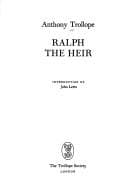
Domestic fiction; England -- Fiction; Fathers and sons -- Fiction; Inheritance and succession -- Fiction
Sir Thomas, who only just remembered the appearance of the man in the
House, at once took an extravagant dislike to him. It was abominable
to him to be called Underwood by a man who did not know him. It was
nauseous to him to be forced into close relations with a man who
seemed to him to be rough and ill-mannered. And, judging from what
he saw, he gave his colleague credit for no good qualities. Now Mr.
Griffenbottom had good qualities. He was possessed of pluck. He was
in the main good-natured. And though he could resent an offence with
ferocity, he could forgive an offence with ease. "Hit him hard, and
then have an end of it!" That was Mr. Griffenbottom's mode of dealing
with the offenders and the offences with which he came in contact.
In every house they entered Griffenbottom was at home, and Sir
Thomas was a stranger of whom the inmates had barely heard the name.
Griffenbottom was very good at canvassing the poorer classes. He said
not a word to them about politics, but asked them all whether they
didn't dislike that fellow Gladstone, who was one thing one day
and another thing another day. "By G----, nobody knows what he is,"
swore Mr. Griffenbottom over and over again. The women mostly said
that they didn't know, but they liked the blue. "Blues allays was
gallanter nor the yellow," said one of 'em. They who expressed an
opinion at all hoped that their husbands would vote for him, "as 'd
do most for 'em." "The big loaf;--that's what we want," said one
mother of many children, taking Sir Thomas by the hand. There were
some who took advantage of the occasion to pour out their tales of
daily griefs into the ears of their visitors. To these Griffenbottom
was rather short and hard. "What we want, my dear, is your husband's
vote and interest. We'll hear all the rest another time." Sir Thomas
would have lingered and listened; but Griffenbottom knew that 1,400
voters had to be visited in ten days, and work as they would they
could not see 140 a day. Trigger explained it all to Sir Thomas. "You
can't work above seven hours, and you can't do twenty an hour. And
much of the ground you must do twice over. If you stay to talk to
them you might as well be in London. Mr. Griffenbottom understands it
so well, you'd better keep your eye on him." There could be no object
in the world on which Sir Thomas was less desirous of keeping his
eye.
[Illustration: "The big loaf;--that's what we want," said one
mother of many children, taking Sir Thomas by the hand.]
Public-domain text, read in full here on John Shaqi.
Reviews
Reviews
No reviews yet
Be the first to share your thoughts on this work.
Elsewhere in the archive
Join the Discussion
Join the discussion
Sign in to leave a comment or review.
Sign InorCreate an account