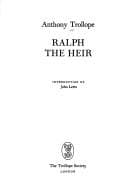
Domestic fiction; England -- Fiction; Fathers and sons -- Fiction; Inheritance and succession -- Fiction
As he thought of this he tried to make the best of it. He had at
any rate rescued himself out of the hands of Neefit, who had become
intolerable to him. As for Polly, she had refused him twice. Polly
was a very sweet girl, but he could not make it matter of regret to
himself that he should have lost Polly. Had Polly been all alone in
the world she would have been well enough,--but Polly with papa and
mamma Neefit must have been a mistake. It was well for him, at any
rate, that he was out of that trouble. As regarded the Neefits, it
would be simply necessary that he should pay the breeches-maker the
money that he owed them, and go no more either to Conduit Street or
to Hendon.
And then what else should he do,--or leave undone? In what other
direction should he be active or inactive? He was well aware
that hitherto he had utterly wasted his life. Born with glorious
prospects, he had now so dissipated them that there was nothing left
for him but a quiet and very unambitious mode of life. Of means he
had sufficient, if only he could keep that sufficiency. But he knew
himself,--he feared that he knew himself too well to trust himself
to keep that which he had unless he altogether changed his manner of
living. To be a hybrid at the Moonbeam for life,--half hero and half
dupe, among grooms and stable-keepers, was not satisfactory to him.
He could see and could appreciate better things, and could long for
them; but he could not attain to anything better unless he were to
alter altogether his mode of life. Would it not be well for him to
get a wife? He was rid of Polly, who had been an incubus to him, and
now he could choose for himself.
He wrote to his brother Gregory, telling his brother what he had
done. The writing of letters was ever a trouble to him, and on this
occasion he told his tidings in a line or two. "Dear Greg., I have
accepted my uncle's offer. It was better so. When I wrote to you
before things were different. I need not tell you that my heart is
sore for the old place. Had I stuck to it, however, I should have
beggared you and disgraced myself. Yours affectionately, R. N." That
was all. What more was to be said which, in the saying, could be
serviceable to any one? The dear old place! He would never see it
again. Nothing on earth should induce him to go there, now that it
could under no circumstances be his own. It would still belong to a
Newton, and he would try and take comfort in that. He might at any
rate have done worse with it. He might have squandered his interest
among the Jews, and so have treated his inheritance that it must have
been sold among strangers.
Public-domain text, read in full here on John Shaqi.
Reviews
Reviews
No reviews yet
Be the first to share your thoughts on this work.
Elsewhere in the archive
Join the Discussion
Join the discussion
Sign in to leave a comment or review.
Sign InorCreate an account