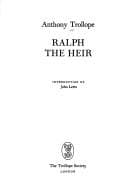
Domestic fiction; England -- Fiction; Fathers and sons -- Fiction; Inheritance and succession -- Fiction
The reader may remember a certain trifling incident which took place
some three or four months since on the lawn at Popham Villa. It was
an incident which Clary Underwood had certainly never forgotten. It
is hardly too much to say that she thought of it every hour. She
thought of it as a great sin;--but as a sin which had been forgiven,
and, though a grievous sin, as strong evidence of that which was
not sinful, and which if true would be so full of joy. Clary had
never forgotten this incident;--but Ralph had forgotten it nearly
altogether. That he had accompanied the incident by any assurance of
his love, by any mention of love intended to mean anything, he was
altogether unaware. He would have been ready to swear that he had
never so committed himself. Little tender passages of course there
had been. Such are common,--so he thought,--when young ladies and
young gentlemen know each other well and are fond of each other's
company. But that he owed himself to Clarissa Underwood, and that he
would sin grievously against her should he give himself to another,
he had no idea. It merely occurred to him that there might be some
slight preparatory embarrassment were he to offer his hand to Mary
Bonner. Yet he thought that of all the girls in the world Mary Bonner
was the one to whom he would best like to offer it. It might indeed
be possible for him to marry some young woman with money; but in his
present frame of mind he was opposed to any such effort. Hitherto
things with him had been all worldly, empty, useless, and at the same
time distasteful. He was to have married Polly Neefit for her money,
and he had been wretched ever since he had entertained the idea. Love
and a cottage were, he knew, things incompatible; but the love and
the cottage implied in those words were synonymous with absolute
poverty. Love with thirty thousand pounds, even though it should have
a cottage joined with it, need not be a poverty-stricken love. He was
sick of the world,--of the world such as he had made it for himself,
and he would see if he could not do something better. He would first
get Mary Bonner, and then he would get the farm. He was so much
delighted with the scheme which he thus made for himself, that he
went to his club and dined there pleasantly, allowing himself a
bottle of champagne as a sort of reward for having made up his mind
to so much virtue. He met a friend or two, and spent a pleasant
evening, and as he walked home to his lodgings in the evening was
quite in love with his prospects. It was well for him to have rid
himself of the burden of an inheritance which might perhaps not have
been his for the next five-and-twenty years. As he undressed himself
he considered whether it would be well for him at once to throw
himself at Mary Bonner's feet. There were two reasons for not doing
this quite immediately. He had been told by his lawyer that he ought
to wait for some form of assent or agreement from the Squire before
Public-domain text, read in full here on John Shaqi.
Reviews
Reviews
No reviews yet
Be the first to share your thoughts on this work.
Elsewhere in the archive
Join the Discussion
Join the discussion
Sign in to leave a comment or review.
Sign InorCreate an account