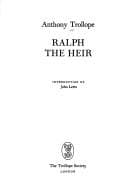
Domestic fiction; England -- Fiction; Fathers and sons -- Fiction; Inheritance and succession -- Fiction
"I hope there will now be an end of all family ill-feeling among us,"
said the uncle. "Your brother shall be as welcome at the old place
as I trust you have always found yourself. If he likes to bring his
horses here, we shall be delighted."
The parson muttered something as to the kindness with which he had
ever been treated, but what he said was said with an ill grace. He
was almost broken-hearted, and thoroughly wished himself back in
his own solitude. The Squire saw it all, and did not press him to
talk;--said not a word more of his purchase, and tried to create some
little interest about parish matters;--asked after the new building
in the chancel, and was gracious about this old man and that young
woman. But Gregory could not recover himself,--could not recall his
old interests, or so far act a part as to make it seem that he was
not thinking of the misfortune which had fallen upon the family. In
every look of his eyes and every tone of his voice he was telling
the son that he was a bastard, and the father that he was destroying
the inheritance of the family. But yet they bore with him, and
endeavoured to win him back to pleasantness. Soon after the cloth was
taken away he took his leave. He had work to do at home, he said, and
must go. His uncle went out with him into the hall, leaving Ralph
alone in the parlour. "It will be for the best in the long run," said
the Squire, with his hand on his nephew's shoulder.
"Perhaps it may, sir. I am not pretending to say. Good night." As he
walked home across the park, through the old trees which he had known
since he was an infant, he told himself that it could not be for the
best that the property should be sent adrift, out of the proper line.
The only thing to be desired now was that neither he nor his brother
should have a child, and that there should no longer be a proper
line.
The Squire's joy was too deep and well founded to be in any way
damped by poor Gregory's ill-humour, and was too closely present to
him for him to be capable of restraining it. Why should he restrain
himself before his son? "I am sorry for Greg," he said, "because he
has old-fashioned ideas. But of course it will be for the best. His
brother would have squandered every acre of it." To this Ralph made
no answer. It might probably have been as his father said. It was
perhaps best for all who lived in and by the estate that he should be
the heir. And gradually the feeling of exultation in his own position
was growing upon him. It was natural that it should do so. He knew
himself to be capable of filling with credit, and with advantage to
all around him, the great place which was now assigned to him, and
it was impossible that he should not be exultant. And he owed it to
his father to show him that he appreciated all that had been done
for him. "I think he ought to have the L35,000 at least," said the
Squire.
"Certainly," said Ralph.
Public-domain text, read in full here on John Shaqi.
Reviews
Reviews
No reviews yet
Be the first to share your thoughts on this work.
Elsewhere in the archive
Join the Discussion
Join the discussion
Sign in to leave a comment or review.
Sign InorCreate an account