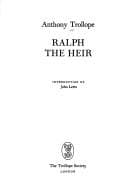
Domestic fiction; England -- Fiction; Fathers and sons -- Fiction; Inheritance and succession -- Fiction
If it be thought that there was something in the letter which should
have been suppressed,--the allusion, for instance, to the possible
but most improbable loss of his father's private means, and his
morbid denial of his own right to a name which he had always borne,
a right which no one would deny him,--it must be remembered that
the circumstances of the hour bore very heavily on him, and that it
was hardly possible that he should not nurse the grievance which
afflicted him. Had he not been alone in these hours he might have
carried himself more bravely. As it was, he struggled hard to carry
himself well. If no one had ever been told how nearly successful the
Squire had been in his struggle to gain the power of leaving the
estate to his son, had there been nothing of the triumph of victory,
he could have left the house in which he had lived and the position
which he had filled almost without sorrow,--certainly without
lamentation. In the midst of calamities caused by the loss of
fortune, it is the knowledge of what the world will say that breaks
us down;--not regret for those enjoyments which wealth can give, and
which had been long anticipated.
At two o'clock on this day he got a telegram. "I will be at the
parsonage this evening, and will come down at once." Ralph the heir,
on his return home late at night, had heard the news, and early on
the following morning had communicated with his brother and with
his namesake. In the afternoon, after his return from Basingstoke,
Gregory again came down to the house, desiring to know whether Ralph
would prefer that the meeting should be at the Priory or at the
parsonage, and on this occasion his cousin bore with him. "Why should
not your brother come to his own house?" asked Ralph.
"I suppose he feels that he should not claim it as his own."
"That is nonsense. It is his own, and he knows it. Does he think that
I am likely to raise any question against his right?"
"I do not suppose that my brother has ever looked at the matter in
that light," said the parson. "He is the last man in the world to do
so. For the present, at any rate, you are living here and he is not.
In such an emergency, perhaps, he feels that it would be better that
he should come to his brother than intrude here."
"It would be no intrusion. I should wish him to feel that I am
prepared to yield to him instantly. Of course the house cannot be
very pleasant for him as yet. He must suffer something of the misery
of the occasion before he can enjoy his inheritance. But it will only
be for a day or so."
"Dear Ralph," said the parson, "I think you somewhat wrong my
brother."
"I endeavour not to do so. I think no ill of him, because I presume
he should look for enjoyment from what is certainly his own. He
and my father were not friends, and this, which has been to me so
terrible a calamity in every way, cannot affect him with serious
sorrow. I shall meet him as a friend; but I would sooner meet him
here than at the parsonage."
Public-domain text, read in full here on John Shaqi.
Reviews
Reviews
No reviews yet
Be the first to share your thoughts on this work.
Elsewhere in the archive
Join the Discussion
Join the discussion
Sign in to leave a comment or review.
Sign InorCreate an account